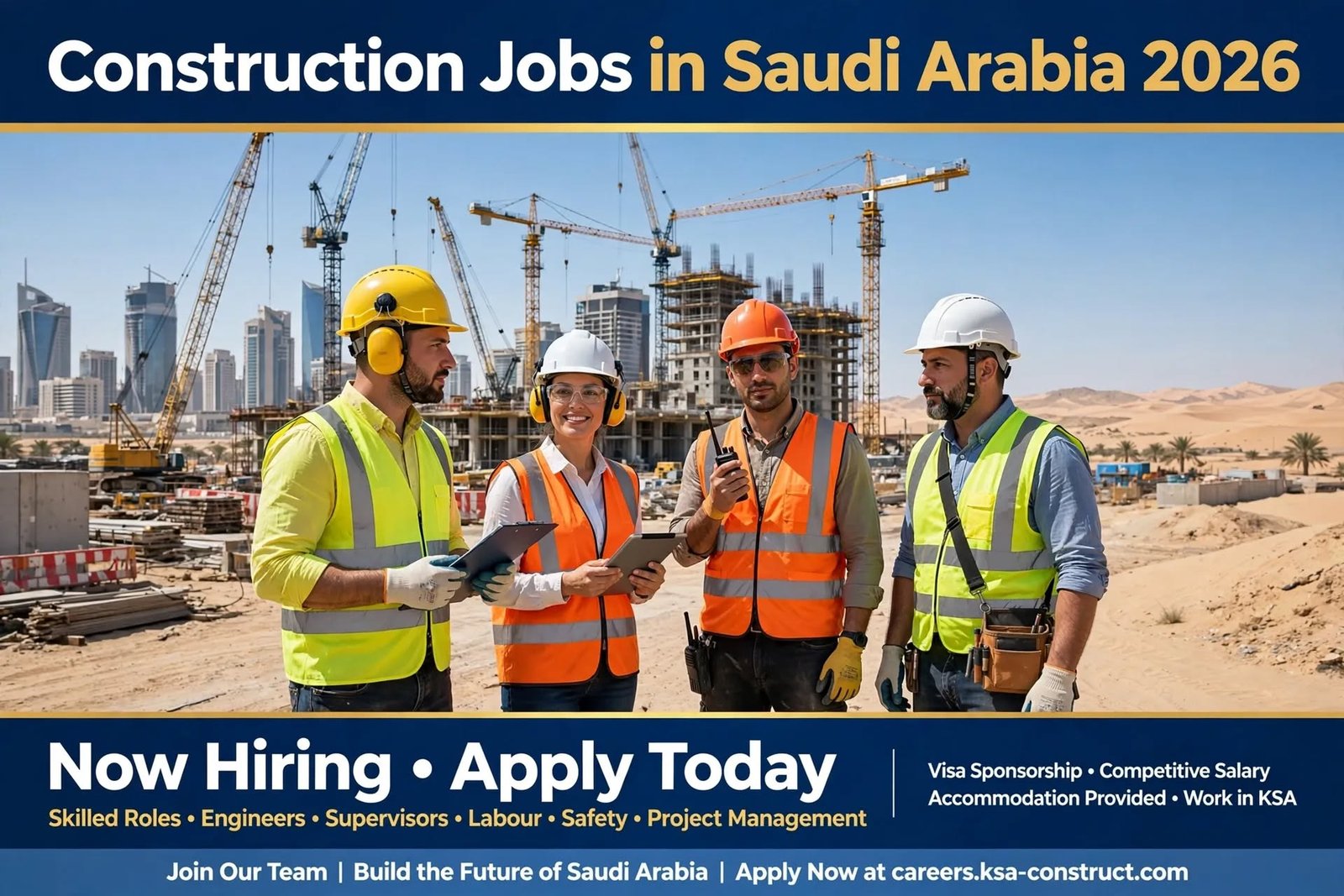
Ask any engineer who has worked in the Gulf to name the most ambitious building programs in the world, and Saudi Arabia will be near the top of the list. Entire cities, tourism destinations, sports venues, transport networks and industrial zones are being planned and built at once.
For construction professionals, that means one thing: opportunity. Civil engineers, project managers, site supervisors, quantity surveyors and safety officers are needed across the Kingdom. If you work in this industry, or want to, understanding how this market works can help you make a smart career decision.
This guide covers why the Kingdom’s construction scale is so large, which roles are most wanted, what skills employers look for, where the jobs are, and how to prepare an application that gets noticed.
Read Also: Data Analyst Jobs in Saudi Arabia
Why Saudi Arabia’s Construction Scale Is Unprecedented
Vision 2030 as the engine
Vision 2030 is the national plan to diversify the economy beyond oil. Much of it is physical: new cities, new airports, new tourism destinations, new industrial clusters and new housing. Each of these needs design, procurement, construction and long-term maintenance, which creates work for thousands of professionals.
The giga-project model
The Kingdom has launched several so-called giga-projects, each larger and more complex than a typical development. Well-known examples include:
- NEOM, a large-scale futuristic development in the northwest
- The Red Sea Project, a luxury tourism destination built with a strong sustainability focus
- Qiddiya, an entertainment, sports and culture destination near Riyadh
- ROSHN, a residential and community development program
- Diriyah, a heritage and cultural redevelopment on the edge of Riyadh
Each one involves multiple contractors, consultants and subcontractors working simultaneously.
Infrastructure to support growth
Beyond the headline projects, the country is investing in metro and rail lines, airport expansion, ports, highways, power plants, water desalination and housing. Hosting major international events has also added urgency to stadium, hotel and transport construction.
A note on shifting timelines
Large programs evolve. Priorities, phasing and schedules for individual projects are reviewed and adjusted over time. For a job seeker, the lesson is practical: aim for skills that transfer between projects rather than tying your plans to a single development. Demand for qualified construction professionals is broad and doesn’t depend on any one site.
The Most In-Demand Construction and Engineering Roles
Civil engineers
Civil engineers are the backbone of the sector. They design and oversee roads, bridges, tunnels, foundations, drainage systems and structures. In giga-project environments they often specialize in infrastructure, geotechnical work or structural design.
Project managers
Project managers keep scope, cost, time and quality under control. On large developments, they coordinate between the client, consultants and contractors, manage risk and report progress to senior stakeholders. Experience with international standards and large budgets is highly valued.
Site supervisors and site engineers
These professionals run the day-to-day work on the ground. They manage crews, check quality, enforce safety procedures, solve problems as they arise and make sure the program is followed.
Quantity surveyors and cost engineers
They estimate costs, manage contracts, measure work and handle variations and claims. Strong commercial awareness is a major advantage.
Planning and project controls engineers
Using tools like Primavera P6 and Microsoft Project, they build schedules, track progress and forecast delays. Project controls is a fast-growing specialty.
MEP engineers
Mechanical, electrical and plumbing engineers design and install the systems that make buildings function: air conditioning, power, lighting, fire protection and water.
HSE officers and managers
Health, safety and environment professionals are essential on large sites. Employers take safety compliance seriously, and qualified HSE specialists are consistently sought after.
BIM specialists and digital construction roles
Building Information Modelling is increasingly expected on major projects. Professionals who can coordinate 3D models, detect clashes and manage digital documentation are gaining ground.
Skilled trades and foremen
Electricians, welders, steel fixers, surveyors, heavy-equipment operators and foremen are also needed in large numbers, particularly on projects running multiple shifts.
Skills and Qualifications Employers Look For
Educational background
Most engineering roles require a bachelor’s degree in civil, structural, mechanical, electrical or construction engineering. Quantity surveying and project management roles often accept degrees in construction management or related fields.
Professional certifications
Recognized credentials strengthen your profile:
- PMP or similar project management certification
- Chartered or professional engineering status from a recognized body
- NEBOSH or IOSH for safety professionals
- Primavera or scheduling certifications for planners
- RICS or equivalent for quantity surveyors
Technical skills
- Reading and interpreting drawings and specifications
- Contract knowledge, including FIDIC-based contracts commonly used in the region
- Scheduling and cost control software
- Quality assurance systems
- BIM tools such as Revit and Navisworks
- Construction methods relevant to your specialty
Soft skills
- Leadership, especially managing diverse, multinational teams
- Clear communication, since site instructions and reports must be precise
- Problem-solving under pressure
- Adaptability to hot climates, long working weeks and changing priorities
- Cultural awareness, which makes cooperation smoother and builds trust
Where the Jobs Are
Riyadh
Riyadh is the largest hub for recruitment and head offices. It hosts major developers, consultancies and government clients, as well as large urban and transport projects.
Jeddah and the Western Region
Jeddah offers coastal development, port expansion, urban renewal and tourism-related building.
Eastern Province
The Eastern Province connects strongly to energy and industrial construction, including plants, refineries and supporting infrastructure.
Northwest and Red Sea regions
Giga-project sites in remote locations often offer attractive packages, but come with camp living, longer rotations and a more isolated lifestyle. Weigh these trade-offs carefully.
Who Hires Construction Professionals?
You will find openings with:
- Giga-project developers and their program management offices
- International and regional EPC contractors
- Engineering and design consultancies
- Government agencies and municipalities
- Real estate developers
- Energy and industrial companies
- Subcontractors and specialist trade firms
- Recruitment agencies that specialize in Gulf construction
Large projects often follow a layered structure: a client, a project management consultant, a main contractor and several subcontractors. Understanding that structure helps you target the right employer for your experience level.
Salary and Package Considerations
Pay differs widely depending on discipline, seniority, employer and location. In the Gulf, the total package often matters more than base salary alone. Look at:
- Housing or housing allowance
- Transport or vehicle allowance
- Medical insurance
- Annual flights home
- End-of-service benefits
- Remote-site or rotation allowances
- Performance bonuses
Salary levels move with market conditions, so use current salary guides and recruiter advice instead of relying on old figures. When you receive an offer, compare the entire package, not just the monthly number.
Life and Work on a Saudi Construction Project
Working conditions
Expect hot weather for much of the year, long working hours and a fast pace. Many sites enforce strict safety rules, mandatory PPE and regular inspections.
Accommodation and living
Some employers provide company housing or camps, while others offer allowances for private accommodation. Major cities offer modern housing, malls, hospitals and international schools. Remote project sites are more basic.
Culture and workplace norms
Respect for local customs, prayer times and the weekly schedule is important. Many workplaces are highly international, so you may work alongside colleagues from dozens of countries.
Localization and knowledge transfer
The Kingdom is actively developing Saudi talent in engineering and project management. International professionals are often expected to train, mentor and share expertise. Approaching this positively builds goodwill and strengthens your own reputation.
A Step-by-Step Guide to Getting Hired
- Define your target role. Be specific: structural engineer, planning engineer, site supervisor or project manager.
- Update your CV for the Gulf market. Highlight projects with scale, budget, duration, your exact role and measurable results. Keep it clear and concise.
- List certifications prominently. PMP, NEBOSH and similar credentials often act as filters in recruiters’ searches.
- Optimize your LinkedIn profile. Recruiters use it heavily. Use industry keywords, show your project history and mark yourself as open to opportunities.
- Work with reputable recruiters. Choose agencies with a track record in construction, and never pay a fee for a job. Legitimate employers do not charge candidates for recruitment.
- Apply directly to company career pages. Contractors, consultancies and developers often post roles there first.
- Prepare for technical interviews. Expect questions on past projects, problem-solving, contracts, safety scenarios and how you manage delays.
- Verify credentials and documentation. Saudi authorities require professional verification for engineers, so start gathering your degree, experience letters and certifications early.
- Understand your contract before signing. Check duration, probation, working hours, notice period, benefits and exit terms.
Challenges and Realities to Consider
A realistic picture will help you decide with confidence.
- Competition is strong for senior positions, and employers often want regional or comparable large-project experience.
- Heat and long hours are part of the job on many sites.
- Family relocation involves planning around housing, schooling and visas.
- Remote locations can mean long periods away from city life.
- Project changes can affect timelines and staffing, so keep your skills current and your network active.
- Recruitment scams exist. Be cautious of offers that seem too good to be true, request upfront fees or come from unverified sources.
Building a Long-Term Career in the Gulf
The strongest professionals treat a Saudi assignment as a stepping stone, not just a paycheck. To build a career with lasting value:
- Seek projects with recognizable names and complex scopes. They strengthen your CV worldwide.
- Earn additional certifications while on assignment.
- Learn digital tools. BIM, drones, data dashboards and project-management software are becoming standard.
- Build relationships with consultants, clients and recruiters.
- Develop leadership skills. Moving from technical specialist to manager brings greater responsibility and reward.
Trends Shaping Construction Careers
Several developments are reshaping the sector:
- Sustainability and green building, driven by national environmental goals
- Digital construction, including BIM, digital twins and drone surveys
- Prefabrication and modular building, which speed up delivery
- Advanced project controls with real-time data
- Focus on safety culture and stricter compliance
- Growing use of AI tools for scheduling, risk analysis and monitoring
Professionals who combine traditional engineering knowledge with these modern skills will have an edge.
Conclusion
Saudi Arabia’s construction landscape offers some of the most varied and demanding work in the world. From giga-projects to city infrastructure, the Kingdom needs civil engineers, project managers, site supervisors and many other specialists to turn plans into reality.
If you are considering this path, prepare carefully: strengthen your credentials, tailor your CV, understand the package and lifestyle, and stay alert to scams. Choose employers and projects wisely, keep your skills current and stay flexible as priorities shift. With the right preparation, a construction career in the Kingdom can be professionally rewarding and globally valuable.
Frequently Asked Questions (FAQ)
1. Why is there so much demand for construction professionals in Saudi Arabia?
Vision 2030 has triggered a large wave of building across cities, tourism, transport, housing and industry, all at the same time, which requires many skilled professionals.
2. Which construction roles are most needed?
Civil engineers, project managers, site supervisors, planning engineers, quantity surveyors, MEP engineers and HSE specialists are consistently in demand.
3. Do I need professional certifications?
They are not always mandatory, but credentials like PMP, NEBOSH or professional engineering status significantly improve your chances and may be required for senior roles.
4. Where are most construction jobs located?
Riyadh is the biggest hub, followed by Jeddah, the Eastern Province and remote giga-project regions in the northwest and along the Red Sea.
5. Is knowing Arabic necessary?
Usually not, as English is widely used on international projects. Basic Arabic helps with daily life and workplace relationships.
6. How do I avoid recruitment scams?
Never pay a recruiter or employer for a job offer, verify the company’s identity, check official career pages, and read your contract carefully before relocating.
7. What should I check before accepting an offer?
Review the full package, including housing, medical cover, flights, bonuses, working hours, probation period and end-of-service terms.
1 thought on “Construction Jobs in Saudi Arabia: Why Engineers and Project Managers Are in Demand”