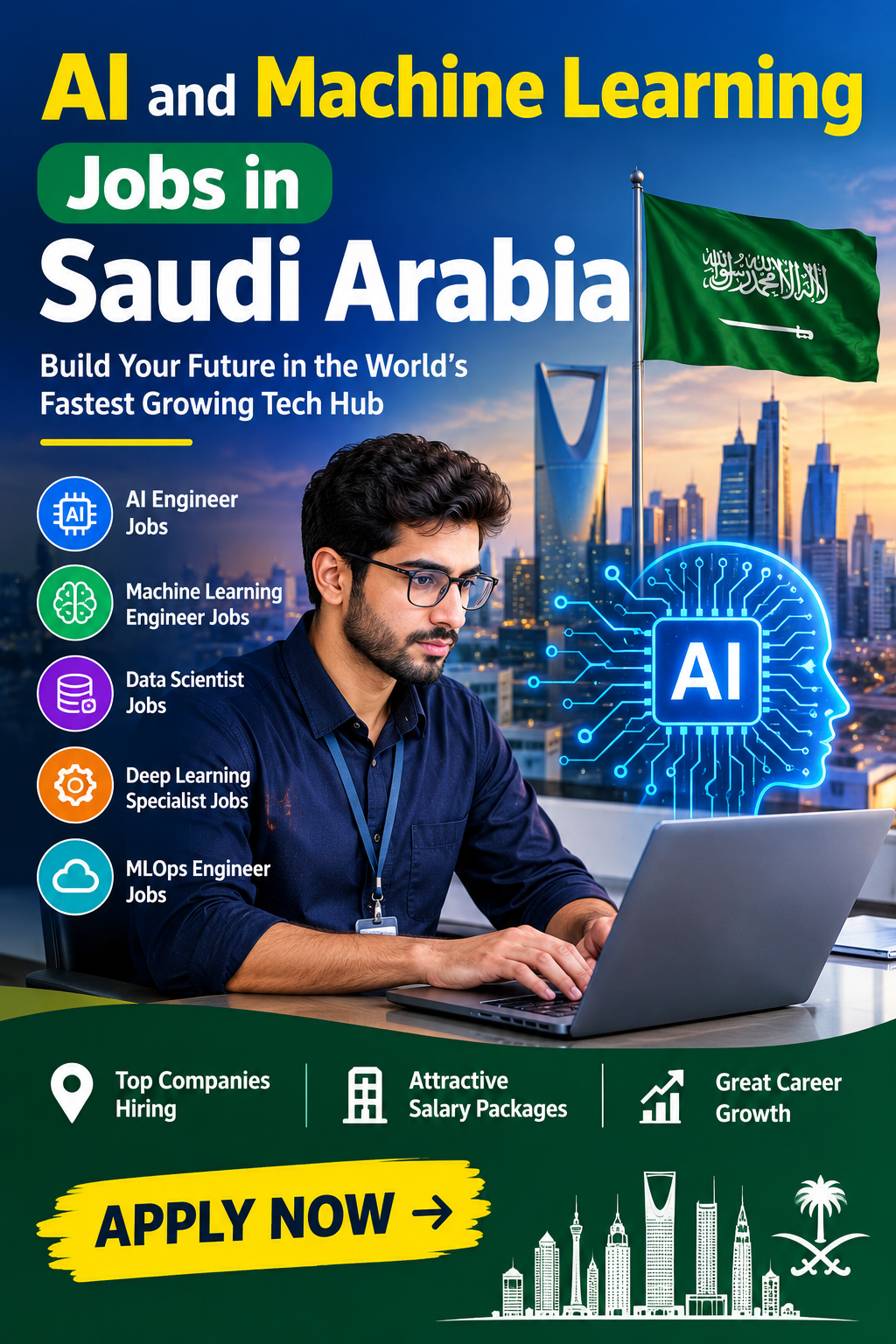
A decade ago, most people linked Saudi Arabia with oil, pilgrimage and desert landscapes. Today, a growing number of engineers link it with something else: artificial intelligence.
The Kingdom has set out to turn itself from a resource-driven economy into a knowledge-driven one. Under Vision 2030, billions of dollars are flowing into smart cities, data centers, digital government services and industrial automation. Every one of those investments needs people who can build, train, test and maintain intelligent systems.
That is why AI and machine learning specialists have become some of the most sought-after professionals in the country. Whether you are a fresh graduate, a software developer thinking about a switch, or an experienced data scientist looking abroad, the Saudi market deserves a close look.
This guide covers why demand has surged, what the work involves, which skills matter, what employers expect and how you can position yourself.
Why Saudi Arabia Is Betting Big on Artificial Intelligence
Vision 2030 and economic diversification
Vision 2030 is the Kingdom’s long-term plan to reduce dependence on oil revenue. Technology sits at the center of it. Leaders see AI as a way to raise productivity, create high-value jobs and build industries that can compete globally.
Government backing and dedicated institutions
Saudi Arabia has created institutions specifically for data and AI. The Saudi Data and AI Authority (SDAIA) leads national strategy, data governance and AI research. The country has also backed large-scale AI investment vehicles and infrastructure, including data centers and computing capacity. When a government treats AI as national infrastructure, hiring follows.
Read Also: Healthcare Jobs in Saudi Arabia
A young, digital-first population
A large share of the Saudi population is under 35 and comfortable with smartphones, e-commerce and digital payments. That creates both a big market for AI-powered products and a growing local talent pool, which companies are keen to train alongside international hires.
NEOM and Smart Cities: Where AI Meets Urban Planning
What smart cities need from AI
NEOM is the most talked-about example, but the smart-city idea reaches across the Kingdom. A truly connected city runs on data from sensors, cameras, vehicles, utilities and mobile apps. Machine learning helps make sense of it.
Typical smart-city applications include:
- Traffic and mobility optimization, predicting congestion and adjusting signals
- Energy management, forecasting demand and balancing solar and wind supply
- Water and waste systems, detecting leaks and optimizing collection routes
- Public safety and emergency response, using computer vision and predictive analytics
- Personalized citizen services, through chatbots and recommendation engines
A note of realism on mega-projects
Large projects like NEOM are complex, and timelines and priorities have been reviewed and adjusted over time. For job seekers, the takeaway is simple: don’t build your whole plan around one project. The underlying demand for AI skills spans many employers, sectors and cities, so a flexible approach is safer.
Digitizing Industries: Beyond the Mega-Projects
Smart cities get the headlines, but much of the real hiring comes from established industries going digital.
Energy and utilities
Oil and gas companies use machine learning for predictive maintenance, reservoir analysis and emissions monitoring. Renewable energy firms use it to forecast solar and wind output. These are data-rich environments where even small efficiency gains translate into large savings.
Healthcare
Hospitals and health-tech companies use AI for medical imaging support, patient-flow forecasting and administrative automation. As the healthcare sector expands, so does demand for data professionals who understand both algorithms and clinical workflows.
Banking and fintech
Fraud detection, credit scoring, customer-service automation and personalized financial products all depend on ML. Saudi banks and fintech startups actively recruit data scientists and ML engineers.
Government and public services
Digital government platforms need analytics, document-processing tools and citizen-facing assistants. Arabic-language AI, including natural language processing for Arabic dialects, is a particularly valuable niche.
Logistics, retail and tourism
With the growth of e-commerce, new ports and logistics hubs, and a push to expand tourism, companies need demand forecasting, route optimization and recommendation systems.
What Does an AI and ML Specialist Actually Do?
“AI specialist” is an umbrella term. Here are the most common roles you will see in job listings.
Machine learning engineer
Builds, trains and deploys models into real products. Strong in Python, software engineering practices and cloud platforms.
Data scientist
Explores data, builds predictive models and communicates insights to business teams. This role mixes statistics, coding and storytelling.
NLP and Arabic language specialist
Works on language models, chatbots, translation and speech systems. Fluency in Arabic can be a major advantage here.
Computer vision engineer
Develops systems that interpret images and video, used in security, manufacturing, healthcare and traffic management.
MLOps engineer
Keeps models running reliably in production through pipelines, monitoring and automation.
AI product manager and AI ethics or governance specialist
Bridges the technical and business sides, and ensures systems are fair, transparent and compliant with data regulations.
Skills You Need to Compete
Technical skills
- Programming: Python is the standard, with SQL for data work. R, Java or C++ can help in some roles.
- Core ML knowledge: supervised and unsupervised learning, model evaluation, feature engineering
- Deep learning frameworks: PyTorch and TensorFlow
- Generative AI and large language models: prompt design, fine-tuning, retrieval-augmented generation
- Cloud and infrastructure: AWS, Azure or Google Cloud, plus Docker and Kubernetes
- Data engineering basics: pipelines, data warehousing, big-data tools
- Mathematics: linear algebra, probability and statistics
Soft skills
- Communication: explaining complex models to non-technical managers
- Problem framing: turning a vague business need into a solvable data problem
- Cross-cultural collaboration: Saudi workplaces are international, and teamwork across backgrounds matters
- Adaptability: tools change fast, so learning agility counts for a lot
Qualifications and Career Paths
Most employers look for a bachelor’s degree in computer science, data science, engineering, mathematics or statistics. Advanced roles, especially in research, often prefer a master’s or PhD.
That said, a strong portfolio can offset a lighter academic record. Employers increasingly value proof of practical ability: deployed projects, competition results, open-source contributions and relevant certifications.
A typical progression looks like this:
- Junior data analyst or ML associate
- Data scientist or ML engineer
- Senior or lead specialist
- Principal engineer, head of AI or data science manager
Some professionals move into product, consulting or startup founding along the way.
Salary Expectations
Pay depends on experience, employer, location and whether the role comes with housing or other allowances. Technology roles in the Kingdom generally pay competitively, particularly for senior specialists, and packages often include benefits beyond base salary.
Rather than relying on a single headline number, do this:
- Check current salary guides from recruitment firms
- Compare listings on major job boards
- Ask recruiters about the total package, including housing, transport, health insurance and annual flights
Salary data changes quickly, so always verify recent figures before negotiating.
Who Is Hiring?
You will find AI-related openings across several types of organizations:
- Government and semi-government bodies focused on data and digital transformation
- Energy and industrial giants modernizing operations
- Banks and fintech companies
- Telecom and technology firms
- Mega-project developers and smart-city initiatives
- Global consultancies and tech companies with regional offices
- Startups and venture-backed companies, especially in Riyadh
Riyadh is the main hub for recruitment, followed by Jeddah and the Eastern Province. If you are targeting a job in the Kingdom, expect most opportunities to be concentrated in these areas.
How to Land an AI Job in Saudi Arabia: A Step-by-Step Plan
- Build a strong foundation. Master Python, SQL, statistics and core ML concepts before chasing advanced topics.
- Create a project portfolio. Include two or three solid projects, ideally with a regional angle: Arabic text classification, energy forecasting or traffic analysis, for example.
- Learn modern AI tools. Familiarity with generative AI and cloud deployment now appears in many job descriptions.
- Tailor your CV. Keep it concise, results-focused and compatible with applicant tracking systems. Use the keywords from each job description.
- Optimize your LinkedIn profile. Recruiters in the Gulf rely heavily on LinkedIn. Add a clear headline, project links and relevant keywords.
- Network actively. Join AI communities, attend virtual or in-person tech events and connect with recruiters and professionals already in the region.
- Understand the visa and work process. Employers usually handle work visas, but check the latest requirements and whether your profession needs credential verification.
- Prepare for interviews. Expect coding tests, case discussions about applying ML to business problems and questions about past projects.
- Consider learning basic Arabic. It isn’t mandatory for most technical jobs, but it helps with daily life and can set you apart.
Challenges to Be Aware Of
No career move is perfect, and honest preparation helps.
- Competition for senior roles can be high, and employers often want proven experience.
- Localization goals, meaning the push to hire and develop Saudi nationals, shape hiring priorities. International professionals should expect knowledge-transfer to be part of the role.
- Cultural and lifestyle adjustment takes time, particularly regarding working hours and social norms.
- Fast-changing priorities in large projects mean flexibility is essential.
- Skill gaps are real: employers say they struggle to find candidates who combine technical depth with business understanding. That is your opportunity if you can show both.
The Road Ahead
Several trends suggest the demand for AI talent in the Kingdom will continue:
- Generative AI adoption across customer service, content, coding and enterprise tools
- Arabic-language AI, a field where regional expertise is valuable
- Growth in data-center and computing infrastructure
- Industry-specific AI in energy, healthcare, finance and logistics
- Stronger focus on responsible AI, including privacy, governance and regulation
Professionals who keep learning and pair technical skill with domain knowledge will be best placed to benefit.
Conclusion
Saudi Arabia’s investment in AI is neither a passing trend nor a single-project story. It spans government strategy, industrial modernization, smart cities and a rapidly changing private sector. That combination has made AI and machine learning specialists some of the most valuable professionals in the Kingdom’s job market.
If you are considering this path, start with the fundamentals, build visible proof of your skills, learn how the local market works and stay flexible. The opportunities are real, but they reward people who prepare thoroughly.
Frequently Asked Questions (FAQ)
1. Why is demand for AI specialists rising in Saudi Arabia?
Because of Vision 2030, large investments in smart cities and digital infrastructure, and the push to modernize industries like energy, healthcare and finance with data-driven tools.
2. Do I need a master’s degree to get an AI job there?
Not always. A bachelor’s degree in a relevant field plus a strong portfolio can be enough for many roles. Research-heavy positions often prefer postgraduate qualifications.
3. Which programming languages should I learn first?
Python and SQL are the essentials. Add a deep-learning framework like PyTorch or TensorFlow and basic cloud skills as you progress.
4. Is knowing Arabic necessary?
Usually not for technical roles, but it is a strong advantage, especially in NLP, government-facing projects and customer-oriented products.
5. Which city has the most AI jobs?
Riyadh, followed by Jeddah and the Eastern Province.
6. Can foreigners work in this field in Saudi Arabia?
Yes. Many international professionals work in the Kingdom’s tech sector, though employers also prioritize developing Saudi talent, so expect a collaborative, knowledge-sharing environment.
7. How can I find current openings?
Use LinkedIn, major Gulf job boards and company career pages, and follow recruitment agencies that specialize in technology hiring.
1 thought on “AI and Machine Learning Jobs in Saudi Arabia: Why the Kingdom Is Hungry for Talent”