Italy is one of Europe’s biggest manufacturing countries. Its food, beverage, fashion, pharmaceutical and logistics industries all need people to sort, pack and label products. That makes packing jobs in Italy a realistic entry point for foreign workers. The work is manual and the hours are fixed, and formal experience is rarely required. Getting a legal work visa, however, takes planning.
What Does a Factory Packing Worker Do?
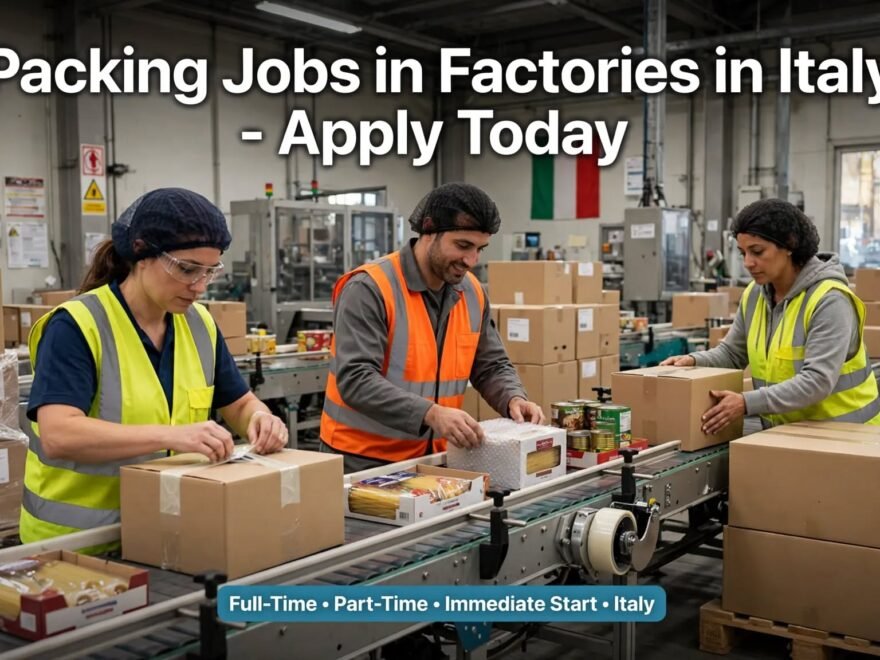
- Sort, weigh and pack finished products into boxes or cartons
- Operate or supervise packaging machines and conveyor lines
- Label and seal packages and check quality
- Load pallets and keep the work area clean and safe
Shifts are usually 8 hours a day, 40 hours a week, and some plants run night or rotating shifts.
Where the Jobs Are
Most factory jobs in Italy are in the industrial north: Lombardy, Veneto, Piedmont and Emilia-Romagna. Common sectors are food processing, beverages, cosmetics, pharmaceuticals and e-commerce logistics. Employment agencies such as Adecco and Manpower list packing and warehouse roles. Always confirm a company’s identity before sharing documents.
Read Also: Jobs on Fruit Farms in Italy: Complete Guide for Foreign Workers
Salary and Expenses
Packing pay follows national collective labour agreements (CCNL), which vary by sector. As a rough guide, entry-level workers often earn about €1,200–€1,600 net per month, depending on region, shift and overtime. Treat this as an estimate and check the contract.
- Rent: a shared room is typically €250–€450 per month, higher in Milan
- Food and transport: roughly €250–€400 per month
- One-off costs: visa fees, translations, flights and health insurance
Work Visa and Legal Requirements
Non-EU citizens generally need a sponsoring Italian employer and a place under the annual quota system, the Decreto Flussi. The 2026–2028 decree authorises 497,550 entries over three years. Non-seasonal employed work gets 76,200 places each year, and the sectors have been expanded to include logistics and textiles. migrants calendar click day 2026 planned new flows decree AHebfQTB +2
The process works like this:
- The employer applies for a work authorisation (nulla osta) through the Ministry of the Interior’s online portal on a fixed “click day”.
- The 2026 click day for non-seasonal workers was 16 or 18 February, and employed-work applications cannot be filed after the click day. The 2026 round is closed, so watch for the 2027 dates. eiglawarlettipartners
- Once approved, you apply for the visa at the Italian embassy or consulate in your country.
Eligibility and Required Documents
- A valid passport with enough remaining validity
- A job offer or employment contract from an Italian employer
- The approved nulla osta
- Proof of accommodation in Italy
- A clean criminal record certificate
- Passport photos, a visa application form and health insurance
- Translated and legalised certificates, if requested
Step-by-Step Application Process
- Prepare a simple CV and a valid passport.
- Search for legitimate employers or licensed agencies.
- Get a written job offer.
- Your employer applies for the nulla osta on click day.
- Apply for the visa at the embassy or consulate.
- After arrival, apply for your residence permit (permesso di soggiorno) within 8 days.
Official Portals
- Ministry of the Interior (ALI portal) for work authorisation applications
- Italian visa portal (vistoperitalia.esteri.it)
- EURES, the EU job mobility portal
- ANPAL and the Ministry of Labour websites
Beware of Scams
Never pay anyone who “guarantees” a visa or a quota place. Legitimate employers apply on your behalf, so verify every offer on the official portals.
Read Also: Italy Farm Worker Jobs
FAQs
Do I need experience for packing jobs?
Usually not. Basic training is provided on site.
Is Italian required?
Not always, but basic Italian helps you get hired and promoted.
Can I apply after click day?
Not for employed work in that round. Prepare early for the next one.
How long does the process take?
End-to-end processing currently runs about 2 to 6 months. migaku
Conclusion
Packing work in Italian factories can be a stable, legal route into the European job market. Start early, verify employers, rely only on official portals, and plan for the next Decreto Flussi round. Rules and quotas change, so confirm details on official Italian government websites before you apply.
-
Packing Jobs in Factories in Italy: Salary, Visa and How to Apply
Italy is one of Europe’s biggest manufacturing countries. Its food, beverage, fashion, pharmaceutical and logistics industries all need people to sort, pack and label products. That makes packing jobs in Italy a realistic entry point for foreign workers. The work is manual and the hours are fixed, and formal experience is rarely required. Getting a…
-

Jobs on Fruit Farms in Italy: Complete Guide for Foreign Workers
Italy is one of Europe’s largest fruit producers, and every year its farms need thousands of extra hands. Fruit farm jobs in Italy are mostly seasonal. Workers pick, sort, prune, and pack apples, grapes, kiwis, citrus, peaches, and more. The work is physical but needs little formal education, which is why it attracts many foreign…
-
Car Wash Jobs in Italy: Salary, Visa Rules and How to Apply
Italy has one of Europe’s largest car markets, so cleaning and detailing vehicles is steady work. Car wash jobs in Italy are popular with newcomers because they usually need no degree and little experience. Whether you are already in the country or planning a move, this guide covers pay, visa requirements and the application process.…