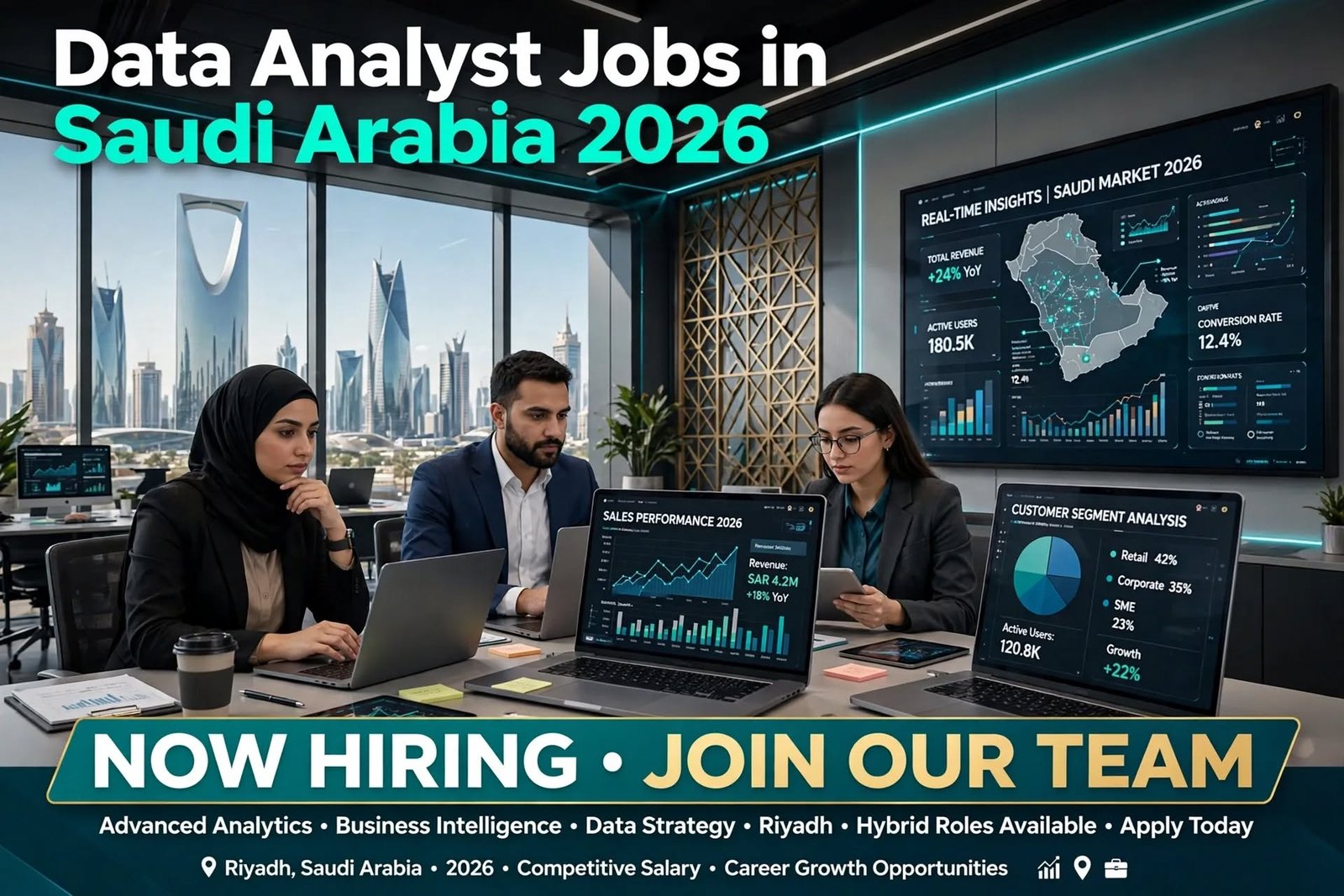
You may have heard the phrase “data is the new oil.” In a country built on oil, that line carries extra weight. Saudi Arabia has decided that information, like energy, can be a source of long-term national strength, and it is acting on that belief.
Government agencies, banks, hospitals, retailers, utilities and giga-project developers all produce enormous volumes of data. Collecting it is the easy part. The harder part is cleaning it, organizing it, protecting it and turning it into decisions. That work falls to data analysts, data engineers, data scientists and governance specialists, and the Kingdom needs more of them.
This guide explains why demand is growing, which roles exist, which skills employers look for, where the jobs are and how to prepare a strong application.
Why Saudi Arabia Wants to Harness the Power of Data
Vision 2030 and the knowledge economy
Vision 2030 aims to move the economy beyond a reliance on oil revenue. A knowledge-driven economy runs on evidence: which services work, where money is wasted, what customers want and how risks are changing. Data skills are central to that shift.
Dedicated national institutions
The Saudi Data and AI Authority (SDAIA) was created to lead national work on data, artificial intelligence and related regulation. Its role covers data governance, national platforms and policy, and it signals that data is treated as strategic infrastructure rather than a side activity of individual departments.
Digital government
Public services are moving online at speed. Digital identity, e-payments, electronic permits and national platforms generate huge streams of data. Agencies need professionals who can measure performance, spot problems and improve services using evidence.
Read Also: Healthcare Jobs in Saudi Arabia
Private-sector competition
Banks, insurers, telecom firms, retailers and logistics companies compete on how well they understand customers. Better analytics means better pricing, targeting, fraud detection and supply-chain planning. Companies that don’t build data teams risk falling behind.
Large-scale development
Giga-projects, new transport networks, hospitals and tourism destinations all depend on forecasting, planning and monitoring. Data supports decisions about capacity, cost, safety and sustainability from the design stage through operations.
The Main Data Roles in Demand
Job titles in this field overlap, and employers use them differently. Here is a practical breakdown.
Data analyst
Data analysts collect, clean and interpret data to answer business questions. They build reports and dashboards, track performance indicators and explain trends to managers. It is the most common entry point into the field.
Business intelligence (BI) analyst or developer
BI specialists design the dashboards and reporting systems that leaders use every day. They work heavily with tools such as Power BI and Tableau and connect to data warehouses.
Data engineer
Data engineers build the pipelines and storage systems that move data from source to destination reliably. They work with databases, cloud platforms and automation, and their work makes analysis possible.
Data scientist
Data scientists go beyond reporting to build predictive models, run experiments and apply statistics and machine learning to complex problems.
Data governance and data quality specialist
As regulations tighten, organizations need people to define data standards, manage ownership, protect privacy and ensure quality. This is a fast-growing specialty, especially in government and finance.
Analytics manager and chief data officer
Senior leaders set data strategy, manage teams and align analytics with business goals. These roles require both technical understanding and strong stakeholder management.
Domain-specific analysts
Healthcare analysts, financial analysts, supply-chain analysts, marketing analysts and risk analysts combine data skills with industry knowledge, which makes them highly valuable.
Skills Employers Look For
Technical skills
- SQL: the core language for querying databases. Almost every data job asks for it.
- Python or R: for data cleaning, analysis, automation and modeling
- Excel: still widely used, especially for quick analysis and reporting
- Visualization tools: Power BI, Tableau or Looker for building dashboards
- Statistics: probability, hypothesis testing, regression and sampling
- Data modeling and warehousing: understanding how data is structured and stored
- Cloud platforms: AWS, Azure or Google Cloud
- ETL and pipeline tools: for engineering-focused roles
- Machine learning basics: helpful for analyst roles, essential for data scientists
Business and soft skills
- Asking the right questions: the best analysts understand the business problem before touching the data
- Storytelling: turning findings into clear recommendations
- Attention to detail: small errors in data can lead to big mistakes in decisions
- Stakeholder management: working with managers who may not be technical
- Curiosity and continuous learning: tools and techniques change quickly
- Cross-cultural communication: teams are often international
The value of Arabic
Technical roles are usually conducted in English, but Arabic is a clear advantage, especially in government-facing roles, customer-focused analytics and text-based projects such as sentiment analysis of Arabic content.
Education and Qualifications
Most employers look for a bachelor’s degree in one of these areas:
- Computer science or software engineering
- Statistics or mathematics
- Data science or information systems
- Economics, finance or business analytics
- Engineering
More advanced roles, especially in research and data science, may prefer a master’s degree. That said, practical proof counts heavily. A good portfolio, relevant certifications and real project experience can make up for a less traditional background.
Helpful certifications include:
- Microsoft Power BI or Azure data certifications
- Google Data Analytics or similar professional certificates
- Cloud provider data-engineering certifications
- Tableau certifications
- Project management or agile certifications for leadership paths
Where the Jobs Are
Riyadh
Riyadh is the center of government, finance and corporate headquarters, so it hosts the largest share of data roles. Many national agencies, banks, telecom companies and technology firms are based here.
Jeddah and the Western Region
Jeddah offers opportunities in retail, logistics, banking and tourism-related analytics.
Eastern Province
The Eastern Province is strong in energy, industrial operations and related analytics, including operational data and predictive maintenance.
Giga-project and emerging hubs
Large development projects and new economic zones are building their own data teams, often with a mix of remote and on-site arrangements.
Who Hires Data Professionals?
- Government ministries and national authorities
- Banks, insurers and fintech companies
- Energy and utility companies
- Telecom and technology firms
- Healthcare providers and health-tech companies
- Retail, e-commerce and logistics businesses
- Real estate and giga-project developers
- Consultancies and professional-services firms
- Startups and venture-backed companies
Consultancies are often a good entry point because they expose you to many sectors quickly. Government and large corporations offer stability and scale, while startups can offer faster growth and broader responsibility.
Salary and Package Considerations
Pay varies by role, seniority, employer type and city. Data engineers and data scientists generally command higher pay than entry-level analysts, and governance or leadership roles can pay more again.
Rather than relying on a single figure, look at the full package:
- Base salary
- Housing or housing allowance
- Transport allowance
- Medical insurance
- Annual flights and leave
- Performance bonuses
- End-of-service benefits
- Training and certification budgets
Market conditions change, so check recent salary guides, recruiter advice and current job listings before negotiating.
A Step-by-Step Plan to Break In
- Learn the fundamentals. Start with Excel, SQL and basic statistics. Add Python and a visualization tool next.
- Build a portfolio. Create three or four projects that show the full process: a business question, data cleaning, analysis, visualization and recommendations. Publish them on GitHub or a personal site.
- Use relevant datasets. Projects with a regional flavor, such as retail demand, energy consumption, traffic patterns or public-health indicators, make a stronger impression.
- Earn recognized certifications. They help recruiters filter and trust your skills, especially if you are changing careers.
- Tailor your CV. Show outcomes, not just tools. For example: “built a dashboard that cut reporting time by 40%” is far stronger than “used Power BI.”
- Optimize your LinkedIn profile. Recruiters in the Gulf rely on it. Use clear keywords, link to your projects and follow target employers.
- Network deliberately. Join data communities, attend webinars and local events, and connect with recruiters and practitioners in the region.
- Prepare for assessments. Expect SQL tests, case studies, dashboard exercises and questions about how you handle messy data.
- Check visa and credential requirements. Employers normally handle sponsorship, but you may need to verify degrees and prepare documents early.
- Review the contract carefully. Check probation, working hours, benefits, notice period and relocation support before signing.
Challenges and Realities
A balanced view will help you plan.
- Competition at entry level can be strong, so portfolios and certifications matter.
- Employers often want experience with comparable sectors or large datasets.
- Messy data is the norm. Much of the work is cleaning and organizing, not building flashy models.
- Localization goals mean employers also prioritize developing Saudi talent. International professionals are often expected to share knowledge.
- Different data maturity levels: some organizations have sophisticated platforms, while others are just starting. Ask about the data environment in interviews.
- Scams exist. Be careful with unsolicited offers, and never pay a fee to get a job.
Data Privacy, Ethics and Governance
Data work carries responsibility. The Kingdom has introduced rules around personal data protection, and organizations are expected to handle information carefully.
Professionals should understand:
- Consent and purpose limitation: using data only for stated purposes
- Security and access control: protecting sensitive information
- Data classification: knowing what is public, internal or confidential
- Bias and fairness: making sure analysis and models don’t produce unfair outcomes
- Documentation: recording sources, assumptions and methods
Knowing these topics doesn’t only keep you compliant. It also makes you a more trusted hire.
Trends Shaping Data Careers
- Generative AI tools that speed up coding, analysis and report writing, shifting analysts toward interpretation and judgment
- Self-service analytics, where business users build their own dashboards, increasing the need for good governance and clean data foundations
- Real-time data and streaming, particularly in logistics, finance and smart infrastructure
- Cloud migration, as organizations move away from on-premise systems
- Data governance and privacy roles, growing in importance
- Arabic-language analytics and NLP, an area with strong regional relevance
- Hybrid roles that combine analytics with domain expertise, such as healthcare or finance
The professionals who thrive will be those who combine technical skills with business understanding and strong communication.
Conclusion
Saudi Arabia’s drive to harness data isn’t a passing trend. It runs through national strategy, digital government, private-sector competition and giga-scale development. That makes data analysts and data specialists some of the most valuable professionals in the Kingdom’s job market.
If you want to join them, build solid fundamentals, create a portfolio that proves your ability, learn how the local market works and stay flexible. The opportunities are real, and they reward people who prepare carefully and keep learning.
Frequently Asked Questions (FAQ)
1. Why is demand for data professionals growing in Saudi Arabia?
Vision 2030, digital government, private-sector competition and large development projects all depend on data-driven decisions, which requires skilled analysts, engineers and scientists.
2. What is the best entry-level data role?
Data analyst and BI analyst roles are the most common starting points. They focus on reporting, dashboards and answering business questions with data.
3. Which skills should I learn first?
Start with Excel, SQL and basic statistics, then add Python and a visualization tool such as Power BI or Tableau.
4. Do I need a degree in data science?
Not necessarily. Degrees in related fields such as computer science, statistics, economics or engineering are common, and strong projects and certifications can offset a different background.
5. Is Arabic required?
Usually not for technical roles, but it is a real advantage, especially in government-facing and customer-focused projects.
6. Which city has the most data jobs?
Riyadh has the largest concentration, followed by Jeddah and the Eastern Province.
7. How can I avoid recruitment scams?
Never pay for a job offer, verify the employer through official channels, be cautious of offers that seem too good to be true, and read contracts carefully before relocating.