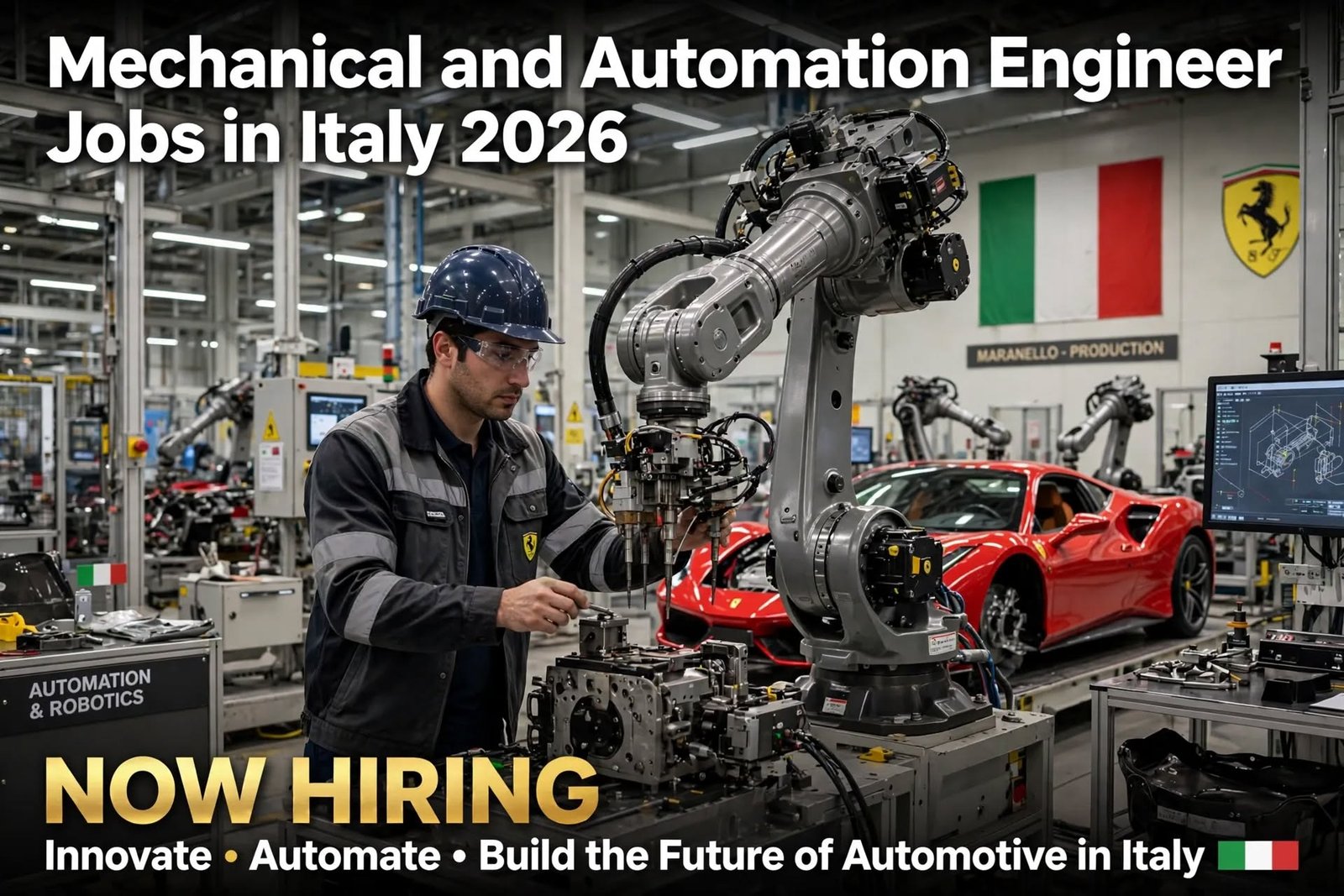
When people think of Italy, they picture Roman ruins, Tuscan hills, and perfect pasta. Engineers see something else: the second-largest manufacturing economy in the European Union, a country that builds supercars, packaging machines, robots, ships, turbines, and precision tools that are exported all over the world.
Behind every Ferrari engine and every automated bottling line in a faraway factory, there is a mechanical or automation engineer working in northern Italy. The country has a deep tradition of engineering, and it now faces a shortage of technical talent as experienced professionals retire and factories upgrade to smart, connected production.
That shortage is your opportunity. This guide covers everything you need to know about mechanical and automation engineer jobs in Italy: where the work is, which companies hire, what you can earn, which skills matter, how visas work, and how to run an effective job search. Read it as a roadmap rather than a promise, because rules and salaries change, and every section points you to what to verify officially.
Why Italy Is a Strong Destination for Engineers
Italy’s industrial strength isn’t a coincidence. It rests on a network of specialized manufacturing clusters, many of them family-owned mid-sized companies that dominate narrow global niches.
A Manufacturing Powerhouse
Italy is a leading exporter of machinery, automotive components, packaging equipment, industrial automation systems, and luxury goods. The country’s “Made in Italy” reputation depends on engineers who can design, test, and improve physical products.
Read Also: Chef & Hospitality Jobs in Italy
Government Support for Industry 4.0
Over the past several years, Italy has encouraged factories to invest in robotics, sensors, data-driven maintenance, and connected machines through national industrial programs and tax incentives. This directly increases demand for automation engineers, PLC specialists, and mechatronics experts.
A Growing Talent Gap
Italian employers regularly report difficulty finding qualified technical staff. An aging workforce and fewer engineering graduates than the market needs mean companies are increasingly open to hiring international candidates.
Mechanical Engineer vs. Automation Engineer: What’s the Difference?
Both roles often work on the same factory floor, but their daily tasks differ.
What Mechanical Engineers Do
- Design and develop components, machines, and systems using CAD software
- Run simulations such as FEA and CFD to test strength, heat, and fluid flow
- Select materials and manufacturing processes
- Oversee prototyping, testing, and quality validation
- Improve efficiency in production, HVAC, energy, and automotive systems
What Automation Engineers Do
- Program and commission PLCs, HMIs, and SCADA systems
- Integrate robots, sensors, drives, and motion control into production lines
- Troubleshoot electrical and control faults during commissioning
- Build industrial networks and connect machines to data platforms
- Reduce downtime through predictive maintenance and process optimization
The Hybrid Role: Mechatronics
Many Italian employers now prefer engineers who understand both sides. If you can read a mechanical drawing and write control logic, you’ll stand out in almost every shortlist.
Where the Jobs Are: Top Industrial Regions in Italy
Italian engineering work is not spread evenly. It is concentrated in a few powerful regions, mostly in the north.
Emilia-Romagna: The Motor Valley
This region is home to famous automotive and motorcycle names, along with the packaging machinery district around Bologna, which supplies food, pharmaceutical, and cosmetics industries worldwide. Expect strong demand for both mechanical designers and automation specialists.
Lombardy: Italy’s Industrial Engine
Milan and its surrounding provinces host machine builders, robotics firms, energy companies, and engineering consultancies. Lombardy offers the largest number of vacancies and the highest salaries, but also the highest living costs.
Piedmont: Turin and Automotive Heritage
Turin remains the center of Italian automotive engineering, with a growing focus on electric mobility, aerospace, and advanced manufacturing.
Veneto and Friuli-Venezia Giulia
These regions feature metalworking, appliance manufacturing, shipbuilding, and a dense network of precision machining companies. Living costs are generally more comfortable than in Milan.
The South: Smaller but Growing
Regions such as Campania and Puglia have aerospace and automotive suppliers. Salaries and vacancy counts are lower, but competition is lighter too.
Top Employers Hiring Engineers in Italy
Italy’s job market has three broad layers, and you should target all of them.
Large Industrial Groups
- Automotive and motorsport: Ferrari, Lamborghini, Maserati, Ducati, Pagani, and Stellantis’ Italian operations
- Aerospace and defense: Leonardo, Avio Aero, and Fincantieri for shipbuilding
- Energy and infrastructure: Enel, Saipem, Ansaldo Energia, and Snam
- Components: Brembo, Pirelli, and Marelli
Automation and Machinery Specialists
Companies such as Comau (robotics), IMA and Marchesini (packaging), Danieli (steel plants), and the Italian divisions of Siemens, ABB, and Schneider Electric regularly hire automation and controls engineers.
Small and Mid-Sized Enterprises (SMEs)
This is where most jobs actually are. Thousands of specialized family businesses, the famous “Mittelstand-style” Italian SMEs, often post vacancies only in Italian or through local networks. Candidates who look beyond big brand names find far less competition.
Mechanical and Automation Engineer Salary in Italy
Salaries in Italy are lower than in Germany or Switzerland, but so is the cost of living outside Milan. Pay varies by region, company size, and industry, so treat these as approximate gross annual ranges and verify with current job postings.
| Experience Level | Approximate Gross Annual Salary |
|---|---|
| Junior (0–3 years) | €25,000 – €32,000 |
| Mid-level (3–8 years) | €33,000 – €48,000 |
| Senior / Lead (8+ years) | €50,000 – €75,000+ |
Automation specialists with strong PLC, robotics, or commissioning experience often sit at the upper end of each band, and field commissioning roles may add travel allowances.
Things That Affect Your Real Income
- Contract type: Many Italian contracts follow national collective agreements (CCNL) for metalworkers, which set minimum pay, leave, and notice periods.
- Extra monthly payments: Italian salaries are commonly paid over 13 or 14 months, so always check whether the quoted figure is annual gross.
- Taxes and contributions: Income tax is progressive, and social contributions are deducted at source. Use an official or reputable net-salary calculator before accepting an offer.
- Benefits: Meal vouchers, supplementary health insurance, and company pension funds are common.
In-Demand Skills Italian Employers Want
Technical ability opens the door, but a few specific skills raise your chances sharply.
Technical Skills
- CAD/CAM tools: SolidWorks, CATIA, Siemens NX, AutoCAD, Fusion 360
- Simulation: ANSYS, Abaqus, or similar FEA/CFD software
- PLC programming: Siemens TIA Portal, Rockwell, Beckhoff, and Schneider platforms
- HMI and SCADA: WinCC, Ignition, or equivalent systems
- Robotics: ABB, KUKA, Fanuc, or Comau programming
- Industrial networks: Profinet, EtherCAT, OPC UA, Modbus
- Quality and lean methods: Six Sigma, lean manufacturing, ISO standards
Soft Skills
- Italian language ability. Even basic Italian signals commitment and helps on the shop floor
- Clear technical English for international projects
- Teamwork across design, production, and procurement
- Willingness to travel for commissioning and client support
Emerging Areas to Watch
- Electric vehicle and battery manufacturing
- Collaborative robots (cobots)
- Digital twins and predictive maintenance
- Energy efficiency, hydrogen, and renewable plant engineering
Visa and Work Permit Options for Foreign Engineers
Immigration rules change often, so confirm every detail on official Italian government and consulate websites before you apply. Here are the main routes people use.
1. EU/EEA/Swiss Citizens
You can live and work in Italy without a work visa. You only need to complete local registration steps after arrival.
2. EU Blue Card
Designed for highly qualified professionals. It generally requires a recognized university degree, a job offer or binding contract, and a salary above a national threshold. Engineers with a bachelor’s or master’s degree often fit this route well.
3. Subordinate Work Visa (Decreto Flussi)
Italy sets annual quotas for non-EU workers through the Decreto Flussi. The employer typically applies for authorization on your behalf during specific application windows, so you need an employer willing to sponsor you.
4. Intra-Company Transfer
If you already work for a multinational with an Italian branch, an internal transfer may be the smoothest route.
5. Study-to-Work Pathway
Completing a master’s degree at an Italian university, such as Politecnico di Milano or Politecnico di Torino, can open doors to a post-study permit and a local network.
Degree Recognition
Non-EU engineers should check how their qualification is recognized. Some roles require a declaration of value or equivalency documentation, and regulated professional practice may require registration with the engineers’ professional order.
Step-by-Step: How to Find Mechanical and Automation Engineer Jobs in Italy
Step 1: Prepare an Italian-Style CV
Use the Europass format or a clean one-to-two page layout. Include your technical stack, software proficiency, notable projects, and language levels. Add a professional photo only if you’re comfortable; it is common but not required.
Step 2: Write a Targeted Cover Letter
Italian recruiters value personalized letters. Name the company, mention a specific product or plant, and explain how your skills match their needs.
Step 3: Search the Right Platforms
- LinkedIn: The best starting point for multinational and larger companies
- Indeed Italia and InfoJobs: Broad job boards with many SME listings
- EURES: The European job mobility portal
- Company career pages: Many industrial firms post directly
- Staffing agencies: Specialized technical recruiters place engineers regularly
Step 4: Use Spontaneous Applications
In Italy, candidatura spontanea (unsolicited application) is common and accepted. Sending a polished CV to an SME’s HR contact can work, especially if you point to a skill they obviously need.
Step 5: Learn Italian While You Search
Start immediately. Even A2-B1 level helps in interviews, relocation, and daily life. Free and paid apps, and courses from the Dante Alighieri Society, can help.
Step 6: Prepare for Interviews
Expect technical questions, a discussion of past projects, and sometimes a practical test. Video interviews are common for international candidates. Be ready to explain how you solved real engineering problems.
Step 7: Review the Contract Carefully
Check the contract type, probation period, applicable CCNL, working hours, notice period, and relocation support. If something is unclear, ask for it in writing.
Common Challenges and How to Handle Them
Language Barriers
Many SMEs operate mostly in Italian. Learning the language is one of the biggest competitive advantages you can build.
Bureaucracy
Residence permits, tax codes (codice fiscale), and registration steps can feel slow. Keep copies of every document and allow extra time.
Salary Expectations
If you’re coming from higher-paying markets, research the local range first. Evaluate the whole package: cost of living, quality of life, and growth opportunities.
Beware of Job Scams
Never pay a recruiter or “agency” money to receive a job offer or visa guarantee. Legitimate employers do not charge candidates, and Decreto Flussi applications go through official channels.
Life as an Engineer in Italy
Work culture in Italian industry is relationship-driven. Colleagues value personal rapport, and lunch breaks are part of the workday rhythm. Standard full-time hours are typically around 40 per week, and annual leave is generous by global standards.
Living costs vary a lot. Cities like Milan and Bologna are pricier, while smaller industrial towns offer comfortable rent and a closer community feel. Public healthcare, strong food culture, easy travel across Europe, and a high quality of life are major reasons many engineers choose to stay long term.
Career Growth Opportunities
Italy rewards expertise that is hard to replace. Typical progression looks like this:
- Junior Engineer → learns systems, supports senior staff
- Project Engineer → owns design or commissioning tasks
- Senior or Lead Engineer → manages technical decisions and teams
- Project or Engineering Manager → leads budgets, clients, and delivery
- Technical Director / Consultant → sets strategy or runs an independent practice
Certifications in project management, functional safety, or specific automation platforms can speed up this path.
Conclusion
Mechanical and automation engineer jobs in Italy offer something many markets can’t: the chance to work on world-famous products inside a manufacturing culture that values craftsmanship. Demand is real, especially in Emilia-Romagna, Lombardy, Piedmont, and Veneto, and companies increasingly look abroad for talent in robotics, PLC programming, and mechatronics.
Success comes down to preparation. Build a strong technical profile, learn Italian, understand the visa route that fits you, and target both big names and the hidden SMEs that make up most of the market. Verify every legal and salary detail through official sources, and be patient with the process.
If you’re serious about an engineering career in Europe, Italy deserves a place at the top of your shortlist.
Frequently Asked Questions (FAQ)
1. Can foreign engineers get jobs in Italy?
Yes. Italian employers hire international engineers, particularly in automation, robotics, and specialized mechanical design. Non-EU candidates need a valid work authorization, usually sponsored by an employer.
2. Do I need to speak Italian?
Not always for multinational or R&D roles, but Italian is strongly recommended. Most SMEs work in Italian, and it greatly improves both hiring chances and daily life.
3. What is the average mechanical engineer salary in Italy?
Typically around €25,000–€32,000 gross for juniors, rising to €50,000+ for experienced seniors. Exact pay depends on region, employer, and contract terms.
4. Which city is best for automation engineers?
Bologna, Milan, and Turin are the strongest hubs, but towns across Emilia-Romagna, Veneto, and Lombardy also have many machine builders and automation firms.
5. Is the EU Blue Card available to engineers?
Often yes, if you hold a recognized degree, have a qualifying job offer, and meet the minimum salary threshold set by Italian authorities. Check the current requirements officially.
6. Which software skills are most valuable?
SolidWorks or CATIA for mechanical work, and Siemens TIA Portal with robot programming for automation roles. Knowledge of industrial networks and SCADA adds further value.
7. Are fresh graduates hired in Italy?
Yes, though competition varies. Internships, master’s projects with companies, and graduate programs at larger employers are common entry points.
8. Is it safe to pay an agent for a job or visa in Italy?
No. Genuine employers and official visa procedures do not require candidates to pay for job offers. Treat any such request as a warning sign.
Disclaimer: Salary ranges, visa rules, and quotas change regularly. Always confirm current details with the Italian Ministry of Foreign Affairs, your nearest Italian consulate, and official government portals before making decisions.