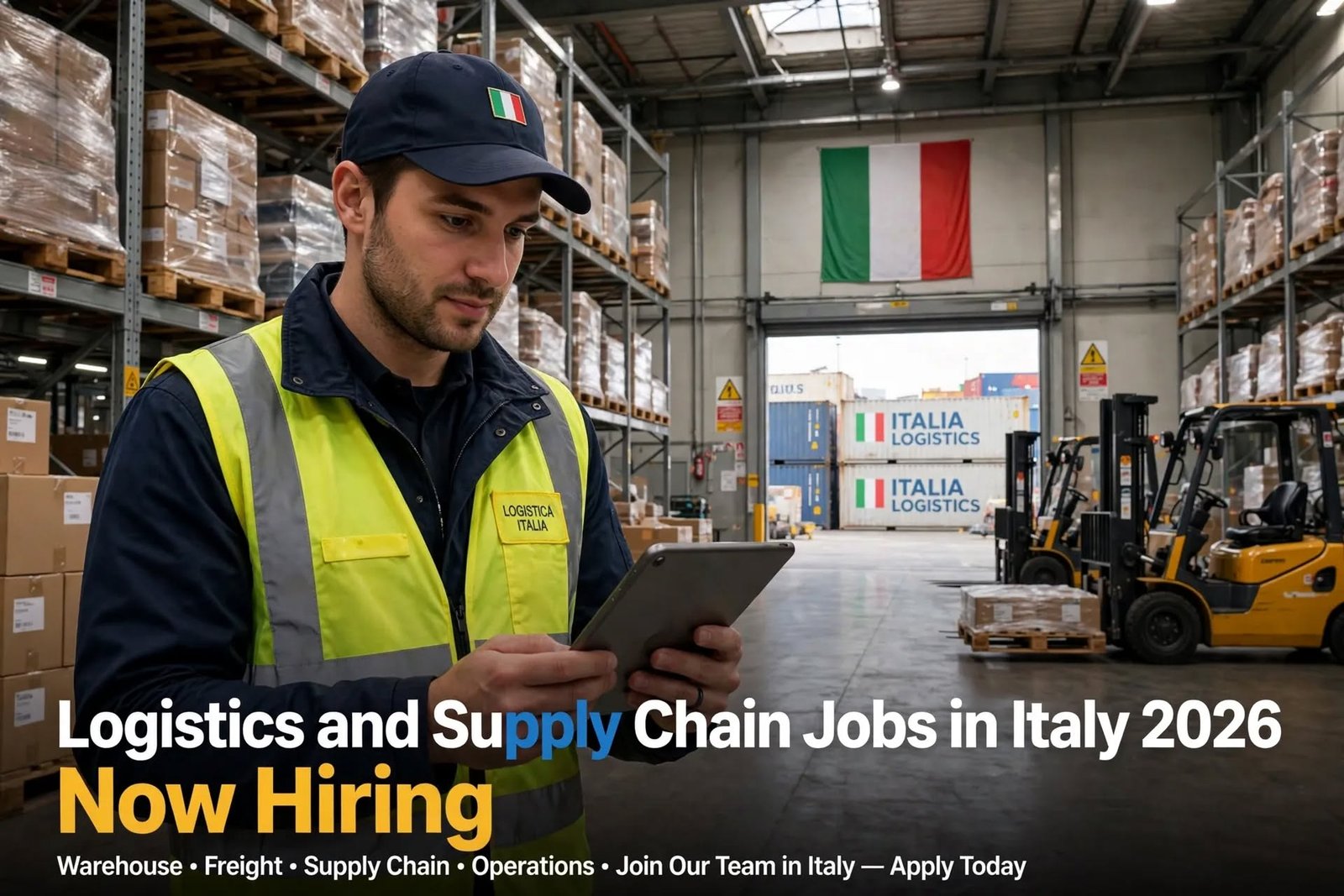
Italy sits at the center of the Mediterranean, and that position is its biggest logistics advantage. Goods moving between Asia, Africa, and Europe pass through Italian ports, rails, and highways every single day. Add a powerful manufacturing base, a famous export culture in fashion, food, machinery, and automotive, and a fast-growing e-commerce market, and you get a sector that constantly needs skilled people.
If you are searching for logistics jobs in Italy, you are looking at one of the country’s most stable employment areas. From warehouse operators in Lombardy to port coordinators in Genoa and supply chain analysts in Milan, the demand runs across experience levels, from entry-level roles to senior management.
This guide walks you through the real picture: which roles exist, what they pay, which skills employers want, how visas work, where the jobs are, and how to apply smartly. Salary and legal details change, so treat figures here as general guidance and verify them with official sources before making decisions.
Why Italy Is a Strong Market for Logistics Careers
Strategic Geography
Italy’s long coastline and its position in the Mediterranean make it a natural gateway. Major ports such as Genoa, Trieste, La Spezia, Gioia Tauro, Livorno, and Venice handle enormous cargo volumes. Inland, the Po Valley forms one of Europe’s densest industrial and distribution corridors.
A Strong Export Economy
Italy is a leading European exporter. Industries such as food and beverage, fashion, furniture, pharmaceuticals, machinery, and automotive parts all depend on efficient storage, transport, and customs handling. Every exported product needs people to plan, pack, move, track, and clear it.
Read Also: Electrician & Renewable Energy Technician Jobs in Italy
E-Commerce and Last-Mile Growth
Online shopping has pushed major retailers and couriers to expand fulfillment centers, especially around Milan, Bologna, Piacenza, and Rome. This has created steady demand for pickers, packers, drivers, and warehouse supervisors.
Investment in Infrastructure
Ongoing investment in rail freight, ports, and intermodal terminals continues to open positions in planning, operations, and compliance. Digitalization, including warehouse management systems, route optimization, and tracking tools, also creates demand for tech-savvy supply chain professionals.
Types of Logistics & Supply Chain Jobs in Italy
The sector is broader than most people expect. Here is a practical breakdown.
Entry-Level and Operational Roles
- Warehouse operator (magazziniere): Receives, stores, and ships goods; handles inventory counts.
- Picker and packer: Prepares orders for dispatch, common in e-commerce and food distribution.
- Forklift operator (carrellista): Operates forklifts and reach trucks; certification is usually required.
- Loader/unloader: Handles loading docks and container movement.
- Delivery driver and courier: Covers last-mile and regional distribution.
Mid-Level Roles
- Warehouse supervisor / team leader: Manages shifts, staff, safety, and performance targets.
- Inventory controller: Monitors stock accuracy and reduces losses.
- Transport coordinator / dispatcher: Plans routes, assigns drivers, and manages delivery schedules.
- Customs and shipping documentation clerk: Prepares import/export paperwork.
- Freight forwarding agent: Arranges sea, air, and road shipments for clients.
Senior and Specialist Roles
- Logistics manager: Oversees warehousing, transport, and cost control.
- Supply chain manager: Coordinates the full chain from supplier to customer.
- Procurement / purchasing manager: Sources materials and negotiates supplier contracts.
- Demand and supply planner: Forecasts demand and aligns production and inventory.
- Supply chain analyst: Uses data to improve efficiency and reduce costs.
- Port operations manager: Coordinates vessel schedules, terminals, and cargo flow.
Salary Expectations for Logistics Jobs in Italy
Pay depends on region, company size, contract type, and experience. Italian salaries are often described as annual gross (RAL, Retribuzione Annua Lorda), and many contracts are set under national collective agreements (CCNL) for logistics, transport, and freight.
Here are broad, indicative ranges. Actual offers vary, so check current job listings and your contract.
| Role | Approximate Annual Gross Range |
|---|---|
| Warehouse operator / picker | €18,000 – €24,000 |
| Forklift operator | €20,000 – €26,000 |
| Delivery driver | €20,000 – €28,000 |
| Warehouse supervisor | €26,000 – €36,000 |
| Freight forwarder / customs clerk | €24,000 – €34,000 |
| Logistics / supply chain analyst | €30,000 – €42,000 |
| Logistics manager | €40,000 – €65,000 |
| Supply chain manager | €50,000 – €80,000+ |
Good to know:
- Northern regions such as Lombardy and Emilia-Romagna generally offer higher pay but also a higher cost of living.
- Italian employees often receive a 13th and sometimes 14th month salary (tredicesima and quattordicesima), which affects total yearly income.
- Night shifts, overtime, and hazardous cargo handling may add allowances.
Top Regions and Cities for Logistics Jobs
Lombardy (Milan, Bergamo, Brescia)
The country’s economic engine. Milan hosts corporate supply chain headquarters, while surrounding provinces are packed with warehouses and distribution hubs.
Emilia-Romagna (Bologna, Piacenza, Parma)
A major logistics hub thanks to its central location, strong food and machinery industries, and large fulfillment centers.
Veneto (Verona, Padua, Venice)
Verona’s freight village and intermodal terminals make it a key node for trade with Northern Europe. Venice and the nearby ports support maritime logistics.
Piedmont (Turin, Novara)
Automotive and industrial supply chains, plus strong rail connections.
Liguria (Genoa, La Spezia)
Port-heavy region with openings in shipping, customs, terminal operations, and freight forwarding.
Lazio (Rome, Civitavecchia)
Government-linked logistics, retail distribution, and the port of Civitavecchia.
Southern Italy (Gioia Tauro, Naples, Bari)
Gioia Tauro is among the Mediterranean’s major transshipment ports. Naples and Bari serve regional trade and growing manufacturing clusters.
Skills and Qualifications Employers Look For
Hard Skills
- Warehouse management systems (WMS) and ERP tools such as SAP.
- Inventory management and stock control methods.
- Forklift certification and workplace safety training.
- Customs procedures and incoterms knowledge for import/export roles.
- Data analysis with Excel, Power BI, or similar tools.
- Transport planning and route optimization.
Soft Skills
- Problem-solving under time pressure.
- Teamwork and communication across languages and cultures.
- Attention to detail, since small errors can cause costly delays.
- Adaptability to seasonal peaks and changing schedules.
Language Skills
Italian is a major advantage and often essential, particularly in operational roles, where safety instructions and teamwork depend on it. Management and international freight roles frequently also require English. Even basic Italian (A2 to B1 level) can noticeably improve your chances.
Education and Certifications
- Operational roles often need no degree, but safety training and forklift licensing matter.
- Analyst and management roles typically look for degrees in logistics, engineering, economics, or business.
- Professional certifications in supply chain management, lean methods, or customs can strengthen a profile.
Work Visa and Legal Pathways for Foreigners
This is the section most international applicants worry about, so read it carefully and verify every detail with official Italian sources.
EU/EEA Citizens
Citizens of EU and EEA countries can live and work in Italy without a work visa. You mainly need to register your residence after arrival.
Non-EU Citizens
Non-EU workers usually need authorization to work. Common routes include:
- Decreto Flussi (annual quota system): Italy sets yearly quotas for non-EU workers in different sectors, including transport and logistics-related roles. Employers apply for authorization on behalf of workers during specific application windows.
- Nulla osta (work authorization): The employer obtains this through the immigration office before the worker applies for the visa.
- Work visa application: After the nulla osta is approved, the worker applies at the Italian consulate in their home country.
- EU Blue Card: For highly qualified professionals with a degree and a qualifying job offer, such as senior supply chain roles.
- Permesso di soggiorno (residence permit): Required after arrival, applied for within days of entering Italy.
Important Warnings
- Quotas, eligible job categories, and dates change every year. Always check the official Italian government and Ministry of Interior websites for current rules.
- Be extremely cautious of anyone asking for large payments in exchange for a guaranteed job or visa. Job-offer scams targeting overseas applicants are common. A legitimate employer does not sell you a visa.
- Never rely on an agent alone. Confirm the employer’s registration and the offer’s details independently.
How to Find Logistics Jobs in Italy
Online Job Portals
Search major Italian and international platforms using Italian keywords, which often return more results than English ones. Useful terms include magazziniere, addetto logistica, carrellista, responsabile logistica, impiegato spedizioni, and supply chain specialist.
Staffing and Temp Agencies
Italy’s employment agencies (agenzie per il lavoro) fill a large share of warehouse and logistics positions, often starting with temporary contracts that can convert into permanent ones.
Direct Applications
Large logistics providers, retailers, couriers, and manufacturers publish openings on their career pages. Applying directly shows initiative and avoids middlemen.
LinkedIn and Networking
For analyst and management roles, LinkedIn is powerful. Connect with recruiters, join logistics groups, and follow companies operating in your target region.
Industry Events and Trade Fairs
Logistics and transport fairs held in Italy are good places to meet employers and learn about industry trends.
Step-by-Step Action Plan to Get Hired
- Define your target role. Decide whether you are aiming for operational, administrative, or management work.
- Build your skills. Earn a forklift license, learn WMS or Excel, and study customs basics.
- Start learning Italian. Even a few months of study helps in interviews and daily life.
- Prepare an Italian-style CV. Use the Europass format or a clean, one-to-two-page CV with a professional photo optional but common, plus a short cover letter.
- Research visa eligibility. Check whether your nationality and role fit the current quota or Blue Card rules.
- Apply widely and consistently. Use portals, agencies, and direct applications together.
- Prepare for interviews. Expect questions on safety, teamwork, shift flexibility, and problem-solving examples.
- Understand your contract. Know your CCNL category, working hours, probation period, and notice terms before signing.
Working Conditions and Life as a Logistics Employee in Italy
Contracts
Common contract types include fixed-term (tempo determinato), permanent (tempo indeterminato), and agency-based temporary work. Permanent contracts offer stronger protection and benefits.
Working Hours
A standard full-time week is around 40 hours, though shift work, nights, and weekends are common in warehouses and delivery operations.
Benefits
Italian employment typically includes paid leave, public healthcare access, pension contributions, and severance-style entitlements (TFR). Specific terms depend on your contract and collective agreement.
Cost of Living
Rent and living costs vary widely. Smaller northern towns and southern cities are often cheaper than Milan or Rome, which matters when comparing salary offers.
Future Trends in Italian Logistics
- Automation and robotics: Automated storage and sorting systems are spreading in larger warehouses, increasing demand for technicians and system supervisors.
- Green logistics: Pressure to cut emissions is boosting interest in rail freight, electric delivery fleets, and sustainable packaging.
- Digital supply chains: Real-time tracking, AI-assisted forecasting, and data-driven planning are reshaping analyst roles.
- Skills shortages: Many companies report difficulty finding qualified drivers, forklift operators, and planners, which can work in favor of well-prepared candidates.
Common Mistakes to Avoid
- Applying without any Italian language effort.
- Ignoring the official visa process and trusting unverified agents.
- Sending the same generic CV to every employer.
- Not reading the contract details before signing.
- Overlooking regional differences in pay and living costs.
Conclusion
Logistics and supply chain work remains one of the most dependable career fields in Italy. Its strategic geography, strong export base, and expanding e-commerce market keep the demand for warehouse staff, drivers, coordinators, analysts, and managers steady. For international candidates, success comes from preparation: build relevant skills, learn at least basic Italian, understand the legal route to employment, and apply carefully through trusted channels.
Start small if you must, perhaps with an operational role or an agency contract, and grow into supervisory or specialist positions. With patience and the right approach, Italy’s logistics sector can offer both a stable income and a long-term career.
Frequently Asked Questions (FAQ)
1. Are there logistics jobs in Italy for foreigners?
Yes. Foreign workers are employed across warehouses, transport, and freight, though non-EU citizens generally need the proper work authorization, such as through the Decreto Flussi system or an EU Blue Card for qualified roles.
2. Do I need to speak Italian to work in logistics in Italy?
For most operational and warehouse jobs, yes, at least at a basic level. International freight and management roles may accept English, but Italian still gives you a major advantage.
3. What is the average salary for a warehouse worker in Italy?
Entry-level warehouse roles commonly fall in the range of roughly €18,000 to €24,000 gross per year, depending on region, shifts, and contract. Check current listings for up-to-date figures.
4. Which Italian city is best for logistics jobs?
Milan and its surrounding Lombardy region offer the most opportunities, followed by Emilia-Romagna, Veneto, and the port-based economies of Liguria.
5. Can I get a work visa for a logistics job in Italy?
It is possible, but it depends on your nationality, the job category, available quotas, and an employer willing to sponsor you. Always confirm current rules with official government sources.
6. Do I need a degree for supply chain jobs in Italy?
Not for operational roles. For analyst, planner, and manager positions, a degree in logistics, business, economics, or engineering is usually expected.
7. How can I avoid job scams when applying from abroad?
Never pay for a guaranteed job offer, verify the employer independently, and rely on official government channels for visa information.
8. Is forklift certification required in Italy?
Yes, operating forklifts generally requires proper training and certification under Italian safety regulations.
Disclaimer: Salary figures, visa rules, and quotas are general guidance and change over time. Verify current details with official Italian authorities and employers before making decisions.