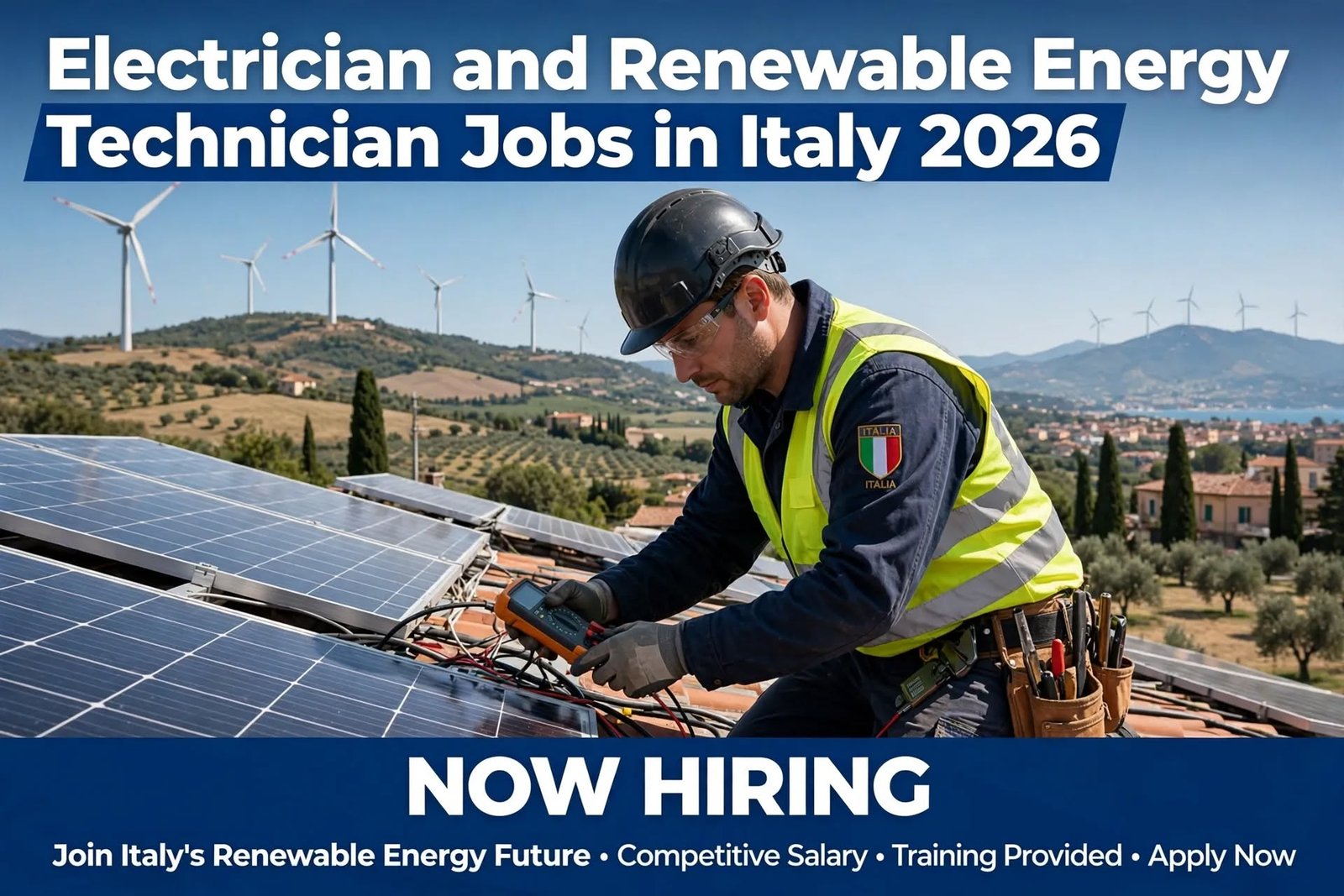
Italy is known for its food, fashion, and history. It is also quietly becoming one of Europe’s most interesting markets for electrical and clean-energy professionals.
The country is racing to modernise its power grid, add solar and wind capacity, and renovate an aging building stock. At the same time, it faces a real shortage of skilled tradespeople. Many experienced electricians are approaching retirement, and fewer young Italians are entering technical trades. Employers are increasingly open to qualified workers from abroad.
If you are an electrician, a solar installer, or a technician with a background in wind, power systems, or industrial maintenance, electrician and renewable energy technician jobs in Italy deserve a serious look.
This guide covers what the jobs involve, which regions hire most, what you can expect to earn, which qualifications and visas matter, and how to start your search.
Why Italy Needs Electricians and Renewable Energy Technicians
The energy transition is driving demand
Italy imports a large share of its energy and has set ambitious targets to expand renewables. Solar capacity has grown quickly across the country, especially in the sunny south. Wind farms continue to expand in Puglia, Sicily, Sardinia, and Basilicata. Offshore wind and energy storage projects are also moving forward.
Every one of these projects needs people to install, connect, test, and maintain the equipment.
An aging workforce and a skills gap
Italian trade associations have warned for years that skilled technical workers are hard to find. Electricians, installers, and maintenance technicians regularly appear on lists of the hardest roles to fill. This gap is the main reason foreign applicants with proven skills have a real opportunity.
Building renovation and grid modernisation
Italy has many older buildings. Energy-efficiency upgrades, heat pump installations, EV charging points, and smart-home systems all require electrical expertise. Grid operators are also investing in network upgrades, which creates steady demand for line workers, substation technicians, and field engineers.
Key takeaway: Demand is not a short-term trend. It is tied to long-term national and European energy goals.
Types of Electrician Jobs in Italy
Residential electrician (elettricista civile)
These electricians wire homes, install lighting and sockets, upgrade consumer units, and carry out repairs. Work is steady, and many residential electricians eventually go self-employed.
Industrial electrician (elettricista industriale)
Italy has a strong manufacturing base, particularly in the north. Industrial electricians work on motors, control panels, PLC-based systems, and production-line machinery. These roles often pay more and may offer better contracts.
Commercial and building-services electrician
This includes offices, hospitals, hotels, shopping centres, and public buildings. Typical tasks are fire-alarm systems, emergency lighting, and building automation.
Maintenance electrician
Factories, logistics hubs, and utilities hire maintenance electricians to keep equipment running. Strong troubleshooting skills are highly valued.
Electrician in the construction sector
Large construction and infrastructure projects need teams to install cabling, distribution boards, and safety systems.
Types of Renewable Energy Technician Jobs in Italy
Solar (photovoltaic) installer
This is currently one of the most accessible entry points. Duties include:
- Mounting panels on rooftops or ground structures
- Running DC and AC cabling
- Installing inverters and monitoring systems
- Testing and commissioning the system
- Connecting battery storage where required
Solar farm maintenance technician
Utility-scale solar plants need ongoing inspections, cleaning management, inverter servicing, and fault-finding.
Wind turbine technician
Wind technicians perform mechanical and electrical maintenance on turbines, often at height. This work is physically demanding and requires safety training, but it pays well compared with many other technical roles.
Energy storage and battery technician
As solar and wind grow, battery systems are becoming essential to balance the grid. Technicians who understand lithium-ion systems, power electronics, and safety protocols are increasingly in demand.
Heat pump and energy-efficiency technician
Heat pumps and efficient heating systems are popular in Italian renovation projects. Electricians who add this skill become more employable.
EV charging infrastructure installer
Charging networks are expanding along motorways and in cities. Installation and maintenance of charging stations is a growing niche.
Where in Italy Are the Best Opportunities?
Northern Italy: industry and commercial work
Lombardy, Veneto, Piedmont, and Emilia-Romagna form Italy’s industrial heartland. Expect strong demand for industrial electricians, automation technicians, and building-services specialists. Wages here are generally higher, though living costs in cities like Milan are also higher.
Central Italy
Tuscany, Lazio, and Umbria offer a mix of construction, renovation, and renewable projects, with steady residential and commercial demand.
Southern Italy and the islands: renewable energy hotspots
Puglia, Sicily, Sardinia, and Basilicata host many large solar and wind projects. If you want to work directly in renewables, these regions are worth targeting. Living costs are typically lower, though salaries can be a little lower as well.
Salary Expectations
Pay varies by region, experience, contract type, and employer, so treat any figure as an estimate and check current job listings and collective agreements.
As a rough guide:
- Entry-level electricians or installers: often fall in the lower range of Italian technical wages
- Experienced electricians: typically earn noticeably more, especially in industrial settings
- Specialised technicians (wind, high-voltage, automation): usually sit at the top of the range
- Self-employed electricians: income can be higher but depends on workload, costs, and taxes
Most employed electricians in Italy work under national collective labour agreements (CCNL), which set minimum pay levels, working hours, holidays, and overtime rules. Italian employment also usually includes a 13th-month payment (tredicesima) and often a 14th month, and employers contribute to social security and severance (TFR).
Tip: Always ask whether the offered salary is gross (lordo) or net (netto). Italian job ads usually quote gross annual pay.
Qualifications and Certifications You May Need
Professional recognition
Italy regulates installation work on electrical systems. Under national rules, companies that install or modify electrical systems must hold the right technical-professional qualifications, and installers issue a declaration of conformity (dichiarazione di conformità) after completing work. Working as a regular employee under a qualified firm is different from running your own installation business, which requires additional registration and a designated technical manager.
Recognition of foreign qualifications
If you trained abroad, you may need your diploma or certificates recognised or validated. Employers often care more about your documented experience, but formal recognition helps, especially for self-employment.
Safety and technical training
Several certifications can strengthen your profile:
- Electrical safety training under Italian standards (commonly referred to as CEI qualifications for live and non-live work)
- Workplace safety courses (mandatory general and specific training under Italian law)
- Working at height certification, essential for roofs and wind turbines
- Global Wind Organisation (GWO) basic safety training for wind work
- Photovoltaic installer training, which some manufacturers also provide
Language skills
You do not need perfect Italian, but you will need working technical Italian for safety instructions, documentation, and teamwork. International energy companies may use English, but most site work happens in Italian. Even a basic A2–B1 level can set you apart.
Work Visas: How Foreigners Can Work in Italy
EU and EEA citizens
You can live and work in Italy freely. Register your residence and obtain a tax code (codice fiscale) after arriving.
Non-EU citizens
Most non-EU workers enter through Italy’s Decreto Flussi system, which sets annual quotas for foreign workers. The general process looks like this:
- Employer applies for authorisation (nulla osta) through the Immigration Desk (Sportello Unico per l’Immigrazione) during the designated application windows.
- Authorities review the request and confirm quota availability.
- You apply for a work visa at the Italian consulate in your country.
- After arrival, you sign the residence contract and apply for a residence permit (permesso di soggiorno).
Quotas, eligible job categories, and procedures change from year to year, and the process can be slow and competitive. Always check official sources, such as the Italian Ministry of Interior, the Ministry of Foreign Affairs, and your nearest Italian embassy, before making plans.
Beware of scams
Unfortunately, fake job offers targeting foreign workers are common. Be cautious if someone:
- Asks you to pay money for a “guaranteed” visa or job
- Promises a contract without any interview or verification
- Contacts you only through messaging apps with no company details
Legitimate employers do not sell visas. Verify the company independently before sending documents or money.
Top Employers and Where to Find Jobs
Major energy companies
Large Italian and international companies operate in generation, distribution, and renewables, including Enel and Enel Green Power, Terna, Edison, A2A, Eni Plenitude, and Iren. They hire technicians, engineers, and field staff, often through their career portals.
Installation companies and contractors
Hundreds of small and mid-sized installers handle solar, electrical, and efficiency projects. These firms are often where first-time foreign applicants find opportunities.
Staffing and recruitment agencies
Italian employment agencies (agenzie per il lavoro) such as Randstad, Adecco, and Manpower place technical workers. Registration with a recognised agency is free for candidates.
Online job platforms
- Indeed Italia
- InfoJobs
- Subito Lavoro
- Company career pages
- The EURES job mobility portal (European Union)
Networking
Trade fairs, industry associations, and professional groups for installers and energy workers can open doors. Italian business culture values personal contacts, so networking pays off.
How to Apply: A Step-by-Step Approach
- Prepare an Italian-style CV. Keep it clear and factual, list your technical skills, certifications, and project experience. Many employers expect a photo-free, one-to-two-page format with a data-protection consent line.
- Write a short cover letter. Explain your trade, your key skills, and your motivation to work in Italy.
- Gather documents. Diplomas, training certificates, reference letters, and passport copies should be organised and, where needed, translated.
- Search targeted job ads. Use keywords such as elettricista, installatore fotovoltaico, tecnico impianti, manutentore elettrico, and tecnico eolico.
- Apply widely. Send tailored applications to companies rather than relying on one portal.
- Prepare for interviews. Expect questions on safety procedures, troubleshooting scenarios, and your experience with specific equipment.
- Check the contract carefully. Confirm pay, hours, accommodation arrangements, and the collective agreement applied.
Life as an Electrician in Italy: What to Expect
Working conditions
Italian workplaces generally operate under strict health and safety regulations. Standard full-time work is around 40 hours per week, with paid holidays and public holidays. In summer, outdoor solar work can be physically demanding, so heat management is part of the job.
Work culture
Italian teams tend to be relationship-driven. Taking time for greetings, respecting experienced colleagues, and showing reliability go a long way. Punctuality and clear communication on safety issues are always appreciated.
Cost of living
Costs vary widely. Cities like Milan and Rome have high rents, while smaller towns and southern regions are more affordable. Many technicians choose to live outside major city centres and commute.
Career growth
A motivated technician can move into roles such as:
- Team leader or site supervisor
- Project coordinator
- Commissioning specialist
- Technical trainer
- Self-employed installer or business owner
Further study, such as technical diplomas or energy-efficiency specialisations, can open more senior positions.
Skills That Make You Stand Out
- Reading electrical schematics and technical drawings
- Testing and measuring with multimeters, insulation testers, and loop testers
- Knowledge of inverters, charge controllers, and battery systems
- Fault-finding and preventive maintenance
- Awareness of European and Italian safety standards
- Comfort working at height and outdoors
- Willingness to learn Italian
- Good teamwork and clear communication
- Basic digital skills for monitoring software and reporting
Challenges to Be Ready For
Being honest about the difficulties will help you plan better:
- Bureaucracy: Paperwork can be slow, and rules differ by region.
- Language barrier: Technical vocabulary takes time to learn.
- Visa competition: Quotas are limited, and timing matters.
- Seasonal variation: Some outdoor renewable work slows in bad weather.
- Regional pay differences: Salaries in the south can be lower than in the north.
None of these are reasons to give up. They are reasons to prepare early and stay organised.
Conclusion
Italy’s push toward clean energy, combined with a shortage of skilled trades, makes this a promising moment for electricians and renewable energy technicians. Whether you want to wire factories in Lombardy, install solar panels in Puglia, or service wind turbines in Sicily, there are real pathways for qualified, motivated people.
Success comes down to preparation: build your technical credentials, learn some Italian, understand the visa process, and use trustworthy channels to find employers. Start small if you need to, gain Italian experience, and grow from there.
If you are ready to take the next step, begin by updating your CV, researching current visa quotas, and shortlisting companies in the region that suits you best.
Frequently Asked Questions (FAQ)
1. Are there enough electrician jobs in Italy for foreigners?
Yes. Italy has a recognised shortage of skilled trades, and electricians and installers are in demand. However, access depends on your visa eligibility and the annual quota system for non-EU workers.
2. Do I need to speak Italian to work as an electrician in Italy?
Not perfectly at the start, but you will need working Italian for safety instructions and teamwork. Learning basic technical vocabulary greatly improves your chances.
3. What is the average electrician salary in Italy?
It varies by experience, region, and sector. Industrial and specialised roles typically pay more than basic residential work. Check current job listings and the relevant collective agreement for up-to-date figures.
4. Which region is best for renewable energy jobs?
Southern regions and the islands, such as Puglia, Sicily, and Sardinia, host many solar and wind projects. Northern regions offer more industrial and commercial opportunities.
5. Can I work as a self-employed electrician in Italy?
Yes, but you must meet professional qualification requirements, register your business, and comply with Italian regulations. Many people start as employees first to learn the system.
6. How do I avoid job scams?
Never pay anyone for a job offer or visa. Verify the employer, insist on a written contract, and use official government and reputable recruitment channels.
7. Is solar installer experience enough to get hired in Italy?
Practical experience helps a lot, especially when combined with safety certifications and some Italian language skills. Additional training in storage or inverter systems can strengthen your application.
Disclaimer: Visa rules, quotas, salaries, and professional requirements change often. Always confirm details with official Italian authorities and employers before making decisions.
1 thought on “Electrician & Renewable Energy Technician Jobs in Italy”