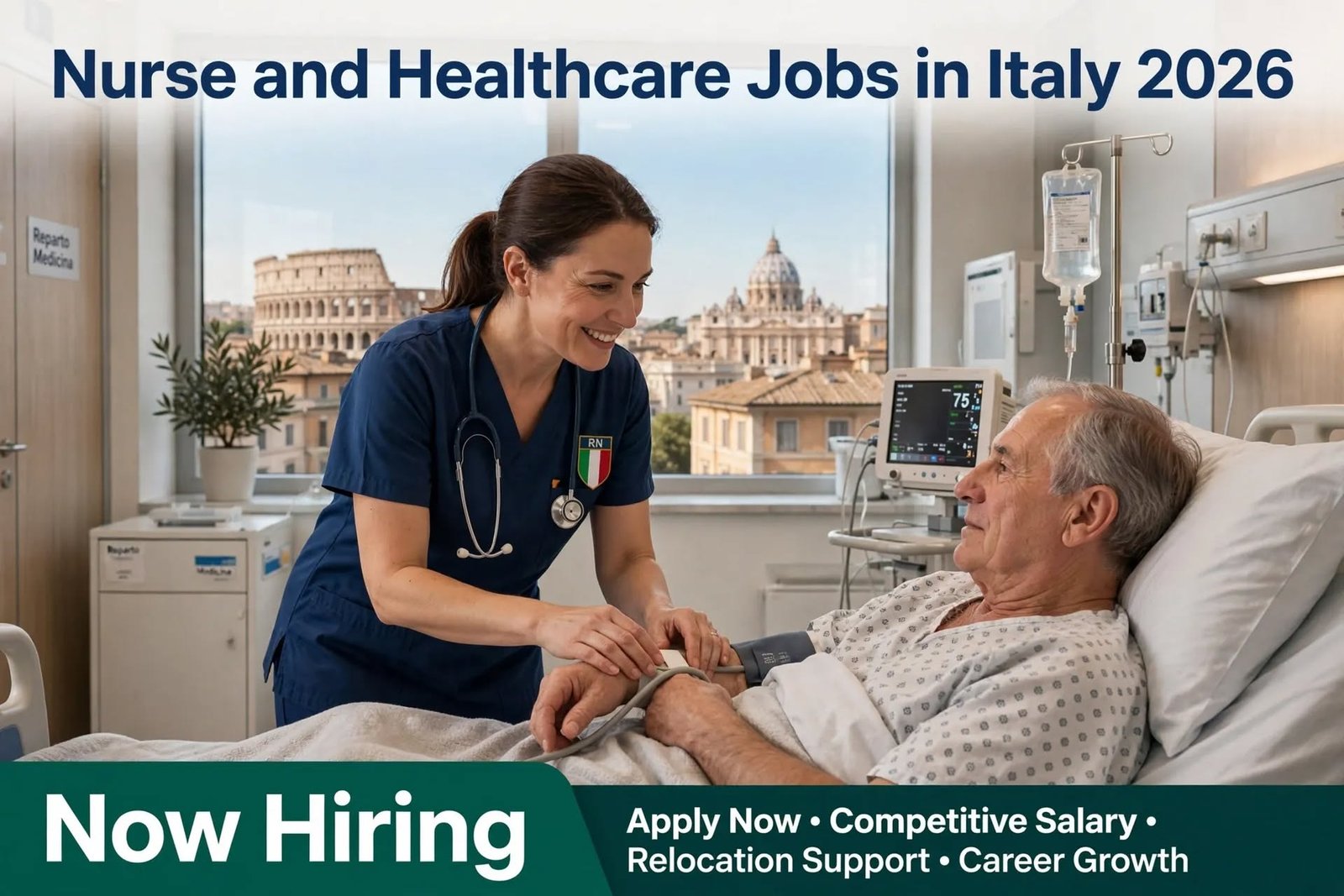
Italy is known for its art, food, and history, but behind the postcards sits a healthcare system that serves around 59 million people. That system depends on nurses, and it needs more of them. Hospitals, care homes, and community clinics across the country have struggled for years to fill nursing positions, and this has opened real opportunities for qualified foreign professionals.
If you are a nurse or healthcare worker thinking about moving abroad, nurse jobs in Italy deserve a serious look. The country offers stable public-sector employment, a good quality of life, and a path to long-term residence. The process is not effortless, though. You will deal with qualification recognition, language requirements, and visa paperwork.
This guide walks you through each step in plain language. It covers demand, job types, pay, licensing, visas, language, job hunting, and the mistakes to avoid.
Important: Rules, quotas, and salary figures change. Always confirm current requirements with official sources such as the Italian Ministry of Health, the Italian embassy or consulate in your country, and the relevant nursing order before making decisions.
Read Also: Software Developer Jobs in Italy
Why Italy Needs Nurses: The Healthcare Staffing Picture
An Ageing Population
Italy has one of the oldest populations in Europe. A large share of residents are over 65, and that raises demand for chronic-disease care, long-term nursing, rehabilitation, and home-based support. More older patients means more nursing hours needed per day.
A Persistent Nurse Shortage
Italy has fewer nurses per head of population than many other Western European countries. Many experienced nurses are approaching retirement, while the number of new nursing graduates has not always kept pace. Hospitals and private facilities have responded by recruiting abroad.
Growth in Private and Long-Term Care
Beyond public hospitals, private clinics, residential care homes (known as RSA, Residenze Sanitarie Assistenziali), and home-care agencies are expanding. These employers often hire quickly and are more open to international candidates.
Types of Nurse & Healthcare Jobs in Italy
The Italian system separates roles clearly, so understanding the titles will save you confusion.
1. Registered Nurse (Infermiere)
This is the main professional nursing role. An infermiere holds a university-level nursing degree and is registered with the professional nursing body. Duties include patient assessment, medication administration, wound care, monitoring, and coordinating with doctors.
2. Specialist and Advanced Nurses
With experience or further training, nurses can work in areas such as:
- Intensive care and emergency
- Operating theatre
- Paediatrics and neonatal care
- Oncology
- Mental health
- Community and family nursing
3. Nursing Assistants and Care Workers (OSS)
The OSS (Operatore Socio-Sanitario) is a healthcare support worker who assists with hygiene, mobility, feeding, and basic patient care under nursing supervision. This is a separate qualified profession in Italy, and it carries its own training requirement.
4. Midwives, Physiotherapists, and Other Allied Professionals
Midwives (ostetriche), physiotherapists, radiographers, and laboratory technicians are also in demand. Each profession has its own recognition process.
5. Home Caregivers (Assistenti Familiari)
Many families hire live-in or hourly caregivers for elderly relatives. This work is common, although it follows different employment and visa routes from regulated nursing.
Where Can You Work? Employers and Settings
Public hospitals (SSN – Servizio Sanitario Nazionale): Stable contracts, strong benefits, and standardised pay scales. Entry is typically through public competitive exams (concorsi), which can be competitive and are usually conducted in Italian.
Private hospitals and clinics: Faster hiring, flexible contracts, and sometimes higher pay for specialised roles.
Residential care homes (RSA): A major source of jobs for both nurses and OSS workers.
Home-care and cooperative agencies: Growing steadily, especially in northern regions.
Rehabilitation and specialised centres: Include physiotherapy, long-term rehabilitation, and psychiatric care.
Regional note: Northern regions such as Lombardy, Veneto, Piedmont, and Emilia-Romagna generally offer more private-sector opportunities, while the south has greater public-sector shortages in some areas. Cost of living also varies sharply between cities.
Nurse Salary in Italy: What Can You Expect?
Pay is a common concern, and it is worth being realistic. Italian nursing salaries are generally lower than in countries such as Germany, the UK, or Switzerland, but the cost of living in many Italian towns is also lower.
Typical Salary Ranges (Approximate)
- Newly qualified registered nurse: roughly €1,500–€1,900 net per month in many public-sector settings
- Experienced nurse with overtime and night shifts: often higher, depending on region and employer
- OSS / care assistant: generally lower than registered nurses
- Private sector or agency work: varies widely and may include extra allowances
These are broad estimates. Actual pay depends on your contract, region, shift pattern, seniority, and employer.
Factors That Affect Your Income
- Night, weekend, and holiday shifts attract extra pay
- Specialisation (such as intensive care) can increase earnings
- Overtime availability differs between employers
- Freelance (libero professionista) nursing offers flexibility but brings tax and insurance responsibilities
- Location: Milan is expensive, while smaller cities offer a lower cost of living
Qualification Recognition: The Most Important Step
Before you can work as a registered nurse in Italy, your qualification must be recognised. This is the part that surprises most applicants, so plan for it early.
EU/EEA Nurses
If your nursing degree comes from an EU or EEA country, recognition generally follows a streamlined European framework. You submit your documents to the Italian Ministry of Health and then register with the local nursing order.
Non-EU Nurses (India, Pakistan, Philippines, Nigeria, and Others)
If you trained outside the EU, the process is stricter. Typically you must:
- Collect your academic documents: degree, transcripts, syllabus details, and proof of clinical hours
- Get official translations and legalisation: documents usually need translation into Italian and proper certification
- Apply for recognition through the Italian Ministry of Health
- Possibly complete a compensation measure: this may include an aptitude test or adaptation period if your training differs from Italian standards
- Register with the provincial nursing order (OPI), which is required to practise
Why Registration Matters
Registration with the Ordine delle Professioni Infermieristiche (OPI) is what legally allows you to work as a nurse. Without it, you cannot hold a registered nurse position, no matter how experienced you are.
Practical Tips
- Start gathering documents early; delays here are common
- Keep several certified copies of everything
- Ask your nursing school for detailed syllabus records
- Be prepared for the process to take months
Language Requirements: Italian Matters
Italian proficiency is not optional in healthcare. You will communicate with patients, families, and colleagues, and you will read patient records and write notes. A misunderstanding in a clinical setting carries real consequences.
What Level Do You Need?
Many employers and registration bodies expect at least B1 to B2 level on the European framework (CEFR), and a higher level is often needed for public-sector work. Some employers offer language support, but you should not count on it.
How to Prepare
- Take structured Italian courses before departure
- Learn medical Italian vocabulary (symptoms, medications, anatomy, procedures)
- Practise listening with Italian healthcare dialogues and news
- Consider recognised language certificates, such as those issued by Italian language institutions
- Speak daily, even in short conversations
Learning Italian is also the single best investment for integration. Patients respond warmly when you make the effort.
Visa and Work Permit Options for Nurses
If you are not an EU citizen, you need legal permission to live and work in Italy. The usual route involves work authorisation and a visa. The details can change from year to year, so verify the current process officially.
Common Pathways
1. Subordinate (employee) work visa:
An Italian employer requests authorisation for you. Italy has historically used annual entry quotas (the decreto flussi) for non-EU workers, although certain categories, including some healthcare professionals, have at times been treated more favourably.
2. Self-employed work visa:
Some nurses work as independent professionals, though this requires meeting specific financial and licensing conditions.
3. EU Blue Card or other skilled-worker routes:
Typically aimed at highly qualified professionals; eligibility depends on the role and salary level.
General Steps
- Secure a job offer from an Italian employer
- Employer applies for work authorisation (nulla osta)
- Apply for the national visa at the Italian consulate in your country
- Enter Italy and apply for a residence permit (permesso di soggiorno) within the required time
- Complete professional registration if not already done
Be Careful With Quotas and Rule Changes
Italian immigration policy shifts. Quotas, eligible categories, and procedures are updated regularly. Check the latest guidance from the Italian Ministry of Interior, the embassy or consulate, and official government portals.
How to Find Nurse Jobs in Italy
Where to Look
- Official public job notices: regional health authorities (ASL / ASST) and hospitals publish competitive exams and vacancies
- Hospital and RSA websites: many list openings directly
- Recruitment agencies specialising in healthcare: some focus on placing foreign nurses
- Professional networks and LinkedIn: useful for private-sector contacts
- Nursing communities and expatriate forums: good for practical experience from people already in Italy
Preparing a Strong Application
- Italian-style CV: clear, concise, with education, clinical experience, languages, and licence status
- Cover letter: short and specific, explaining why you want to work in Italy
- Documents ready: diplomas, licence proof, references, vaccination records
- Proof of language skills: certificates help considerably
Interview Tips
Expect questions about clinical experience, handling emergencies, teamwork, and your Italian level. Employers want to know that you understand the Italian healthcare system and that you intend to stay.
Beware of Scams and Fake Recruiters
Because demand for overseas nursing jobs is high, fraudsters target hopeful applicants. Protect yourself:
- Never pay large “guaranteed visa” fees to unverified agents
- Be suspicious of promises of instant work permits
- Verify the agency’s registration and reputation
- Insist on a written contract before travelling
- Confirm job offers directly with the employer
A genuine employer or licensed agency will not guarantee a visa, because only the authorities decide that.
Life as a Nurse in Italy: Daily Reality
Work Culture
Italian hospitals value teamwork and respect for hierarchy, while relationships with colleagues are usually warm and personal. Shift work is standard, so expect early, afternoon, and night rotations.
Work-Life Balance
Italian employment law provides paid leave, public holidays, and social protections. Public-sector contracts in particular offer security that is harder to find in some other countries.
Challenges to Expect
- Language barriers in the early months
- Bureaucracy, including paperwork for residence, tax, and registration
- Lower pay compared with some neighbouring countries
- Staff shortages that can mean heavy workloads in some facilities
Rewards
- A rich culture, food, and landscape
- Strong public healthcare values
- Travel opportunities across Europe
- A chance to build a long-term professional and personal life
Career Growth and Long-Term Prospects
Specialisation and Training
Italy offers postgraduate programmes, master’s degrees, and specialist training for nurses in areas such as intensive care, community health, and management.
Leadership Roles
With experience you can move toward ward coordinator, clinical coordinator, or management positions.
Residency and Citizenship
Years of legal residence and employment may eventually support applications for long-term residence status and, after meeting the legal requirements, citizenship. Rules for this are strict and change over time, so confirm them officially.
Step-by-Step Action Plan for Aspiring Nurses
- Check your eligibility: nationality, qualification, and experience
- Start learning Italian immediately
- Prepare and translate your documents
- Begin the qualification recognition process
- Research employers and regions
- Apply for jobs and attend interviews
- Handle work authorisation and visa
- Register with the nursing order (OPI)
- Arrange housing and move
- Apply for your residence permit and settle in
Conclusion
Nurse and healthcare jobs in Italy offer real opportunity at a time when the country needs skilled professionals. The route is not instant. Qualification recognition, Italian language ability, and visa procedures all take time, and anyone promising shortcuts should be treated with caution. Yet for nurses willing to prepare carefully, the rewards include stable work, professional growth, and the chance to live in one of the most culturally rich countries in the world.
Start early, stay organised, rely on official sources, and invest in your Italian. With patience and preparation, a nursing career in Italy is achievable.
Frequently Asked Questions (FAQ)
1. Can foreign nurses work in Italy?
Yes. Foreign nurses can work in Italy once their qualification is recognised, they register with the nursing order, and they hold the right work authorisation or visa.
2. Do I need to speak Italian to work as a nurse in Italy?
Yes. Italian is essential for patient safety and daily communication. Most employers expect at least an intermediate level.
3. How long does qualification recognition take?
It varies widely, often several months, depending on your country, documents, and whether a compensation measure is required.
4. What is the average nurse salary in Italy?
Salaries are modest compared with some European countries. Net monthly pay for many nurses falls roughly in the range of €1,500 to €2,000, depending on region, experience, and shifts.
5. Is a job offer necessary for a visa?
For most employee work visas, yes. A genuine job offer and employer-led authorisation are typically required.
6. What is OPI registration?
It is registration with the Italian nursing professional body, which is required to legally practise as a registered nurse.
7. Can I work as a caregiver while my nursing recognition is pending?
Some people work in care-support roles, but this depends on your visa category and the job type. Check the legal rules before accepting work.
8. Are there nursing jobs for non-EU citizens?
Yes, but they involve extra steps, including recognition and visa processes. Quotas and rules apply.
9. Which region is best for nurses?
It depends on your goals. The north often has more private-sector jobs and higher living costs, while the south may have public-sector openings with a lower cost of living.
10. How can I avoid recruitment scams?
Verify agencies, avoid upfront “guaranteed visa” payments, and always confirm offers directly with the employer.
Disclaimer: This article is for general information only and is not legal, immigration, or professional advice. Salary figures are approximate, and regulations change often. Always verify current requirements with official Italian authorities before applying.
I can also write the next role in your series (data analyst, cybersecurity, chef, and so on) in the same format, or prepare a Hindi version of this one.
2 thoughts on “Nurse & Healthcare Jobs in Italy”