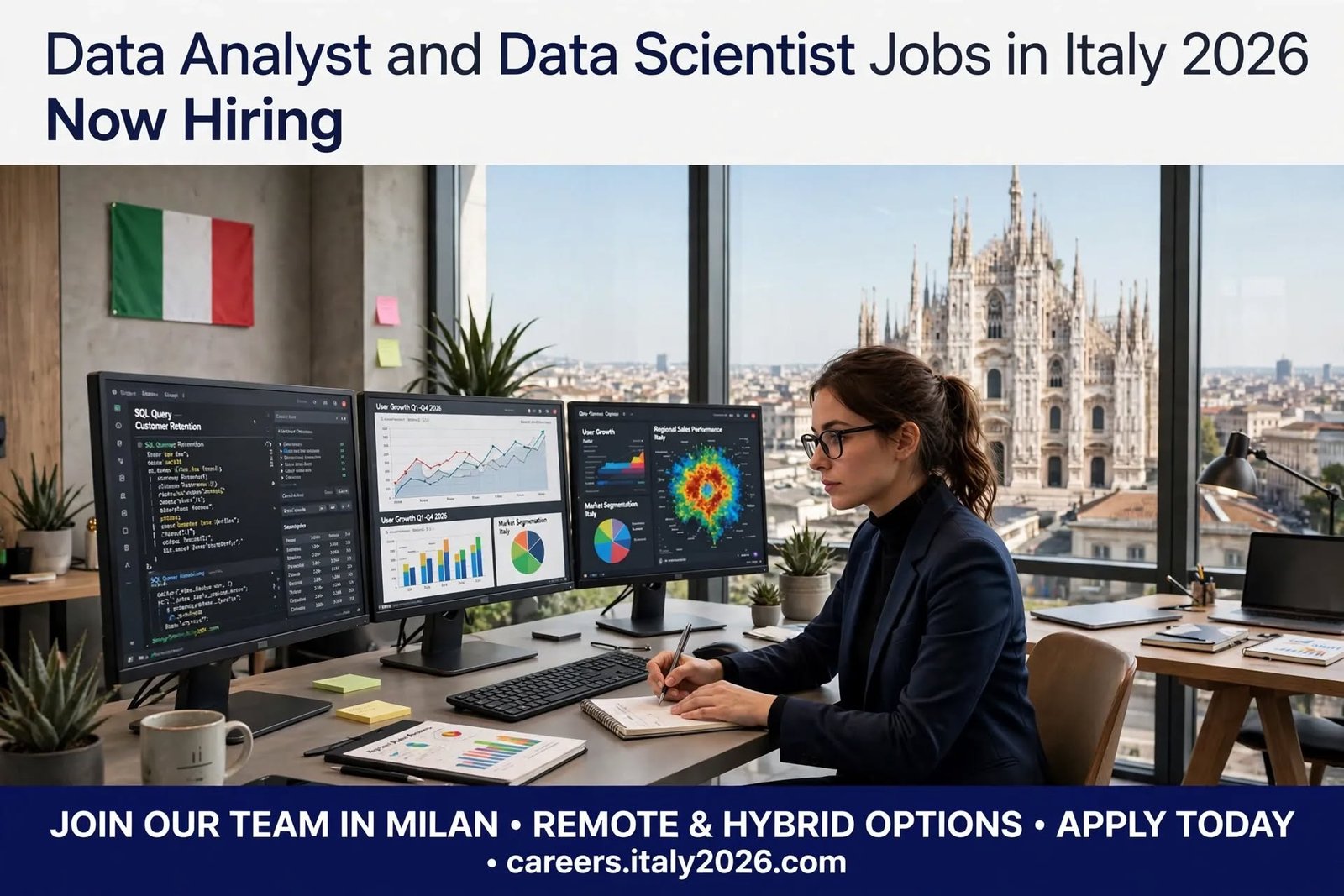
Italy is famous for fashion, food, football and history. Increasingly, it is also becoming a serious market for data talent. Banks, insurers, fashion houses, car makers, energy giants and fast-growing startups all collect huge amounts of information, and they all need people who can turn that information into decisions.
That is why data analyst jobs in Italy and data scientist jobs in Italy deserve attention from anyone building an international career. Companies are digitising quickly, European funding is pushing innovation, and many employers struggle to find enough qualified people. For skilled candidates, local or international, this gap is an opportunity.
In this guide you will learn:
- What data analysts and data scientists actually do in Italy
- Which industries and cities hire the most
- Realistic salary ranges
- The skills employers look for
- How visas and work permits work for non-EU candidates
- Practical steps to find and win a job
Let’s start with the market itself.
Read Also: Nurse & Healthcare Jobs in Italy
Why Italy Is a Growing Market for Data Professionals
For years, Italy was seen as a traditional economy, with strong manufacturing and family-owned companies. That picture is changing, and three forces explain why.
1. Digital Transformation Across Industries
Italian companies in banking, retail, logistics, healthcare and manufacturing are modernising their operations. They are moving to cloud platforms, adopting analytics tools and experimenting with artificial intelligence. Each of these steps creates demand for people who can work with data.
2. Industry 4.0 and Smart Manufacturing
Italy is one of Europe’s leading industrial nations. Factories use sensors, predictive maintenance and quality-control analytics to cut waste and improve output. Data scientists who understand time-series data, IoT signals and forecasting are especially useful here.
3. A Shortage of Skilled Talent
Italian universities produce capable graduates, but demand for advanced analytics skills has grown faster than supply. Many employers also report difficulty hiring experienced machine learning engineers and senior analysts. This gap is a major reason companies are open to international applicants.
Data Analyst vs. Data Scientist: What’s the Difference?
Job titles in Italy can be confusing, and some employers use them loosely. In general, the roles differ like this.
What a Data Analyst Does
A data analyst looks at existing data to answer business questions. Typical tasks include:
- Cleaning and organising datasets
- Writing SQL queries to extract information
- Building dashboards in Power BI, Tableau or Looker
- Tracking KPIs and preparing weekly or monthly reports
- Presenting insights to managers and non-technical teams
What a Data Scientist Does
A data scientist goes further, using statistics and machine learning to predict outcomes and automate decisions. Typical tasks include:
- Building predictive models in Python or R
- Running experiments and A/B tests
- Developing recommendation, forecasting or fraud-detection systems
- Working with large datasets on cloud platforms
- Deploying models together with data engineers
Related Roles You Will See
- Business Intelligence (BI) Analyst
- Data Engineer
- Machine Learning Engineer
- Analytics Consultant
- Marketing or Product Analyst
If you are new to the market, start by searching both Italian and English terms. Italian job boards often use phrases like analista dati, data analyst junior or esperto di business intelligence.
Top Industries Hiring Data Analysts and Data Scientists in Italy
Banking, Finance and Insurance
Major banks and insurers hire analysts for risk modelling, fraud detection, credit scoring and customer analytics. Italy’s large financial institutions and insurance groups run sizeable data teams, and fintech startups add to the demand.
Fashion, Luxury and Retail
Italian fashion is a global brand, and data now shapes how it works. Analysts study customer behaviour, forecast demand, optimise pricing and manage inventory. E-commerce growth has made this field even more active.
Manufacturing and Automotive
From car makers to machinery producers, manufacturers depend on analytics for predictive maintenance, supply chain visibility and quality control.
Energy and Utilities
Energy companies use data for grid optimisation, consumption forecasting and renewable energy planning. As Italy invests in clean energy, these teams keep growing.
Consulting and IT Services
International consulting firms and Italian IT companies hire large numbers of analysts and data scientists. These roles offer fast learning and exposure to many industries, which makes them a good starting point for foreigners.
Healthcare and Pharma
Hospitals, research institutes and pharmaceutical companies use data for clinical research, patient flow analysis and drug development.
Startups and Scale-ups
Italy’s startup scene, centred on Milan, Turin, Rome and Bologna, hires analysts for product, growth and AI-driven roles. Pay can be modest, but the responsibility is often high.
Best Cities for Data Jobs in Italy
Milan
Milan is the undisputed centre for data and technology roles. It hosts corporate headquarters, banks, consultancies, fashion groups and international tech offices. English is more commonly used at work here than in other cities, which helps newcomers. The trade-off is a higher cost of living, especially rent.
Rome
Rome offers opportunities in public administration, energy, telecommunications and consulting. The environment is more institutional, and the pace of hiring can be slower than in Milan.
Turin
Turin has strong roots in automotive and engineering, along with a growing startup and innovation scene. It offers a lower cost of living than Milan.
Bologna
Bologna is known for its university, its research culture and a strong cluster of high-performance computing and AI activity. It is also a pleasant, student-friendly city.
Other Cities Worth Watching
Padua, Verona, Trento, Naples and Florence all have regional employers and research centres that hire data professionals, often with less competition.
Salary Expectations: How Much Do Data Professionals Earn in Italy?
Salaries in Italy are generally lower than in Germany, the Netherlands or Switzerland, but the cost of living outside Milan is also more moderate. The figures below are approximate gross annual ranges and vary by company, city and experience, so treat them as a guide rather than a guarantee.
| Role | Typical Gross Annual Salary |
|---|---|
| Junior Data Analyst | €24,000 – €32,000 |
| Mid-level Data Analyst | €32,000 – €42,000 |
| Senior Data Analyst / BI Lead | €42,000 – €58,000 |
| Junior Data Scientist | €30,000 – €40,000 |
| Mid-level Data Scientist | €40,000 – €55,000 |
| Senior Data Scientist / ML Engineer | €55,000 – €80,000+ |
Factors That Influence Your Pay
- City: Milan usually pays more than southern or smaller cities.
- Company type: International firms and banks often pay above local SMEs.
- Specialisation: Machine learning, cloud and MLOps skills command a premium.
- Seniority: Leadership and domain expertise raise earnings significantly.
- Benefits: Many contracts include meal vouchers, health supplements, bonuses and a 13th month salary, so look beyond the headline figure.
Remember that Italian income tax is progressive and social contributions are deducted, so your net pay will be noticeably lower than the gross figure.
Skills You Need to Get Hired
Core Technical Skills
- SQL: nearly every analyst job requires it.
- Python: the standard for data science, with libraries such as pandas, NumPy and scikit-learn.
- Excel: still widely used in Italian companies, so advanced skills help.
- Data visualisation: Power BI, Tableau or Looker.
- Statistics: hypothesis testing, regression and probability.
Advanced Skills for Data Scientists
- Machine learning and deep learning (TensorFlow, PyTorch)
- Cloud platforms: AWS, Microsoft Azure or Google Cloud
- Big data tools: Spark, Databricks, Snowflake
- MLOps basics: version control, model deployment, monitoring
- Generative AI and NLP, which are increasingly requested
Soft Skills That Make a Difference
- Communication: explaining results in plain language
- Business sense: linking analysis to real decisions
- Teamwork: working across departments
- Adaptability: useful in companies still modernising their processes
Does Language Matter?
Yes. Many multinational and startup roles accept English only, particularly in Milan. But basic to intermediate Italian opens far more doors, and it makes daily life and integration much easier. Even a B1 level shows employers that you are serious about staying.
Education and Certifications
Most employers expect a bachelor’s or master’s degree in a relevant field such as:
- Statistics or mathematics
- Computer science
- Engineering
- Economics or finance
- Physics
For data scientist roles, a master’s degree is common, and a PhD is valued in research-heavy positions. Italy also has well-regarded programmes in data science and analytics at several public and private universities.
Certifications can strengthen your profile, especially if you are changing careers:
- Microsoft Power BI Data Analyst
- Google Data Analytics Certificate
- AWS or Azure data and AI certifications
- Tableau Desktop Specialist
Certificates do not replace experience, but combined with a strong portfolio they show initiative.
Visas and Work Permits for International Candidates
EU and EEA Citizens
If you hold EU, EEA or Swiss citizenship, you can live and work in Italy without a work visa. You only need to complete local registration formalities after arrival.
Non-EU Citizens
Non-EU professionals generally need a visa and work authorisation. The main routes include:
- EU Blue Card: designed for highly qualified workers with a university degree (or equivalent experience) and a job offer that meets a minimum salary threshold.
- Subordinate work visa under the annual quota system (Decreto Flussi): Italy sets yearly quotas for foreign workers, and employers apply on the worker’s behalf.
- Skilled worker and specialist permits: available for certain qualified roles and intra-company transfers.
- Student route: study in Italy, then convert your status to a work permit after graduating, which many international candidates use successfully.
- Digital nomad route: Italy has introduced a visa for remote workers meeting specific income and insurance conditions.
Important: Immigration rules, quotas and salary thresholds change regularly. Always check the latest information on the Italian Ministry of Foreign Affairs website, the Ministry of Interior portal or an official Italian embassy before applying. Never pay anyone who guarantees a visa, since visa fraud targeting job seekers is a real problem.
Where to Find Data Analyst and Data Scientist Jobs in Italy
Online Job Platforms
- LinkedIn: the most useful platform for professional and international roles
- Indeed Italia
- InfoJobs
- Glassdoor (useful for salary and interview insights)
- EURES: the EU’s job mobility portal
- Welcome to the Jungle and startup-focused boards
Direct Applications
Many companies post vacancies on their own careers pages first. Make a target list of banks, consultancies, manufacturers and tech firms, then check their pages weekly.
Recruitment Agencies
Italian and international recruiters specialising in IT and analytics can connect you with roles that never reach public boards.
Networking and Communities
Italy has active data communities, meetups and conferences, particularly in Milan, Rome and Turin. Join local groups, attend events and connect with practitioners on LinkedIn. Referrals carry real weight in the Italian job market.
How to Build an Application That Stands Out
1. Prepare an Italian-Market-Friendly CV
- Keep it to one or two pages.
- Use a clear structure with skills, experience and projects.
- Include a professional photo only if you are comfortable doing so; it is common in Italy but not mandatory for international firms.
- Add a line about your language levels.
- Include the standard privacy authorisation statement, which Italian recruiters often expect.
2. Show, Don’t Just Tell
Build a portfolio on GitHub or a personal site. Good project ideas include:
- A sales dashboard built in Power BI or Tableau
- A customer churn or demand forecasting model
- An analysis of public Italian data, such as open data from ISTAT
- An NLP project on Italian-language text
3. Tailor Every Application
Match your CV to the keywords in the job description. Mention tools and results, such as “reduced reporting time by 30%”, rather than vague duties.
4. Prepare for the Interview
Expect a mix of:
- Technical tests: SQL queries, Python exercises or case studies
- Business case questions: how you would analyse a real problem
- Behavioural questions: teamwork and communication
- Questions about your plans in Italy: employers want to know you will stay
Challenges to Be Aware Of
Honesty helps you plan better, so here are the realities:
- Slower hiring processes: several interview rounds and long decision times are common.
- Lower salaries than northern Europe: offset by lifestyle and, outside major cities, lower costs.
- Bureaucracy: permits, tax codes and registration require patience.
- Language barriers: daily life and many jobs rely on Italian.
- Regional differences: the north offers more openings than the south.
None of these should stop you. They simply mean preparation matters.
Is Italy a Good Choice for Your Data Career?
For many professionals, yes. Italy offers an excellent quality of life, rich culture, good healthcare, central access to Europe and a market that is clearly growing in data and analytics. If you are early in your career, a role in Milan or a consulting firm can give you valuable experience and an international profile. If you value balance, travel and food as much as career progress, Italy has few equals.
Conclusion
Data analyst jobs in Italy and data scientist jobs in Italy are becoming more available as companies across banking, fashion, manufacturing, energy and technology invest in analytics. While salaries may not match those in northern Europe, the combination of career growth, cultural experience and quality of life makes Italy an attractive destination.
To improve your chances, focus on the essentials: learn SQL and Python, build a strong portfolio, pick up basic Italian, target the right cities and understand the visa route that fits your situation. Be patient with the process, apply consistently and keep sharpening your skills.
If you stay persistent and prepared, jobs in Italy in the data field can be a rewarding next step.
Frequently Asked Questions (FAQ)
1. Can foreigners get data analyst jobs in Italy?
Yes. Multinationals, consultancies and startups regularly hire international candidates, especially in Milan. Non-EU applicants will need a valid work visa or permit.
2. Do I need to speak Italian to work as a data scientist in Italy?
Not always. Some international companies work in English. However, knowing Italian greatly improves your job options and daily life.
3. What is the average salary of a data analyst in Italy?
Entry-level analysts typically earn around €24,000 to €32,000 gross per year, rising to €42,000 or more with experience. Actual pay depends on city, company and skills.
4. Which city is best for data jobs in Italy?
Milan has the largest number of opportunities, followed by Rome, Turin and Bologna.
5. Is a master’s degree necessary for data science roles?
It is common and often preferred, but strong experience and a solid portfolio can also open doors, particularly for analyst positions.
6. Which programming languages should I learn first?
Start with SQL and Python. Add Power BI or Tableau for visualisation and R if your field requires it.
7. Can I work remotely for an Italian company?
Some employers offer hybrid or remote roles. If you live abroad, check tax and employment rules carefully, since hiring across borders can be complicated.
8. How long does it take to find a job in Italy?
It often takes two to six months, depending on your profile, language skills and the hiring cycle.
1 thought on “Data Analyst & Data Scientist Jobs in Italy”