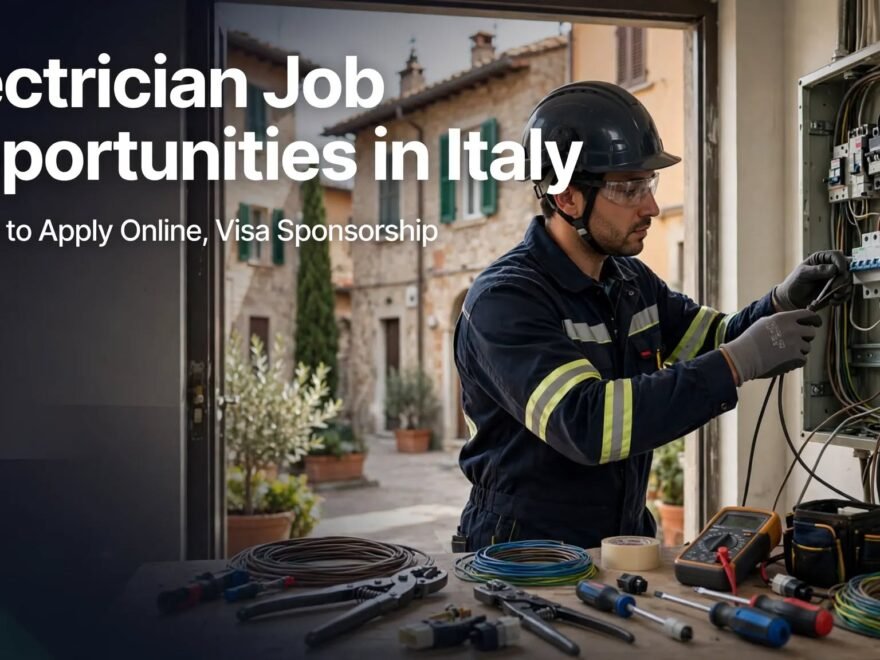
Job Opportunities for Electricians in Italy and How to Apply Online: Italy is known for its food, fashion and history, but behind the postcard image is an economy that depends on skilled tradespeople. Factories, hospitals, hotels, data centres, railways and millions of older homes all need electrical work, and there are not enough qualified electricians to do it. That is good news if you are a trained electrician looking for a stable job abroad.
This guide explains where the electrician jobs in Italy are, what they pay, which skills employers ask for, how the work visa system works, and how to apply online step by step. It also covers how to spot fake job offers, which cost many hopeful workers money every year.
Read it from start to finish before you apply anywhere. A little preparation makes a big difference.
Why Italy Needs Electricians Right Now
Several trends are creating steady demand for electrical workers.
- An ageing workforce. Many Italian electricians are close to retirement, and fewer young Italians are entering vocational trades.
- Renewable energy growth. Italy has strong solar potential, and rooftop and utility-scale photovoltaic projects need installers and technicians.
- Building renovation. Italy has a huge stock of old buildings. Energy-efficiency upgrades and rewiring projects keep contractors busy.
- Industrial automation. The northern industrial belt (Lombardy, Veneto, Emilia-Romagna, Piedmont) needs people who can maintain control panels, motors and production lines.
- Tourism infrastructure. Hotels, resorts and restaurants need reliable in-house maintenance staff.
- Electric vehicle charging. The rollout of charging stations is creating a newer and growing line of work.
Together, these trends mean electricians rarely struggle to find work in Italy once they are legally allowed to take it.
Read Also: Job Opportunities for Plumbers in Italy – Apply Online
Types of Electrician Jobs Available in Italy
“Electrician” covers a lot of ground. Knowing which path suits you helps you write a sharper CV and target the right employers.
Residential Electrician (Elettricista Civile)
You install and repair wiring, sockets, lighting, consumer units and earthing systems in apartments and houses. Work comes from small firms, renovation contractors and sometimes private clients. This is the most common entry point.
Industrial Electrician (Elettricista Industriale)
You work in factories and plants, handling three-phase systems, motors, PLC-controlled equipment and heavy distribution boards. Pay is often higher, and the roles are more stable and structured.
Electrical Panel Builder (Quadrista)
You assemble and wire electrical panels from drawings. This is a respected specialist role, especially in manufacturing zones.
Solar and Renewable Energy Installer
You install photovoltaic panels, inverters and battery storage systems. Demand is rising quickly, and hands-on experience with solar is a real advantage.
Maintenance Electrician
You keep buildings, hotels, hospitals or factories running by inspecting and repairing electrical systems. These jobs often come with a permanent contract.
Construction Site Electrician
You handle temporary power and the electrical fit-out of new buildings. The work is project-based and can involve travel within Italy.
Electric Vehicle Charger Installer
A newer niche covering the installation and commissioning of home and public charging points.
How Much Do Electricians Earn in Italy?
Pay depends on region, contract, experience and sector. The figures below are broad, approximate ranges to help you plan. Always check the actual contract.
| Level | Approximate monthly take-home pay |
|---|---|
| Entry-level / helper | €1,200 – €1,450 |
| Skilled electrician (2–5 years) | €1,450 – €1,800 |
| Experienced industrial / panel specialist | €1,800 – €2,300 |
| Supervisor / team leader | €2,200 – €2,800+ |
A few things to keep in mind:
- Italian wages are usually set by national collective agreements (CCNL), which define pay grades, working hours, paid leave and notice periods. Electricians often fall under the construction, metalworking or installation agreements.
- Many employees receive 13th and 14th month payments, an extra month of salary paid in December and summer. Ask whether it is included.
- The north generally pays more, but living costs in cities like Milan are also higher. A smaller town in the Veneto or Emilia-Romagna regions can leave you better off.
- Overtime, travel allowances and meal vouchers can add to your income.
Skills and Qualifications Employers Look For
Technical Skills
- Reading electrical diagrams and technical drawings
- Installing and testing low-voltage systems
- Fault finding and use of multimeters, insulation testers and similar instruments
- Knowledge of safety standards and earthing
- Experience with panels, motors, PLCs or solar systems (depending on the job)
Formal Qualifications
Italian law is strict about who may install electrical systems. Under the rules that govern installation companies (often referred to as DM 37/2008), a company must have a technically qualified person responsible for its work. As an employed electrician, you work under that person, so you can usually start with a trade certificate or proven experience. If you ever want to run your own electrical business, you will need recognised qualifications and registration, and foreign credentials go through a recognition process.
Helpful documents to prepare:
- A vocational diploma or trade certificate
- Experience letters from previous employers, with dates and duties
- Any safety or specialist certificates (working at height, solar installation, PLC training)
- A clean, up-to-date CV
If your certificates are not in English or Italian, get certified translations. Employers and authorities take documented experience more seriously than verbal claims.
The Language Question
You do not need perfect Italian, but you do need enough to follow safety instructions and understand your team. Aim for at least A2 level before arriving, and keep studying afterwards. Basic technical vocabulary matters too: cavo (cable), interruttore (switch), quadro elettrico (electrical panel), messa a terra (earthing), impianto (system).
Employers notice when a candidate has made an effort to learn the language, and it often tips the decision.
Understanding the Work Visa System
This is the part most people get wrong, so read it carefully.
Citizens of EU countries can work in Italy freely. If you are from outside the EU, you generally cannot just fly in and look for a job. The main legal route for employed work is the Decreto Flussi, Italy’s annual quota system for non-EU workers.
The Key Facts
- An Italian employer must apply for you. A worker cannot file the work authorisation request independently. The employer sends it online, and you wait for the outcome.
- Quotas are limited. According to law firm Arletti & Partners, the three-year decree provides 76,200 entries a year for non-seasonal employed work. Electricians fall in this non-seasonal category, not the seasonal agriculture and tourism categories. arlettipartners
- The click day is competitive. Applications are submitted online on a fixed date, and the quotas can fill quickly.
- The next round is about to open. Pre-filling for the 2027 round runs from 23 October to 7 December 2026, and non-seasonal applications open on a click day on 16 February 2027. Dates and rules can change, so confirm them on official Italian government sources. arlettipartners
- Late applications may still be possible. Applications can still be submitted until 31 December of the relevant year if the application can be filed and quotas remain available. arlettipartners
From Job Offer to Arriving in Italy
- An Italian employer decides to hire you and prepares the application.
- The employer files the request online for the nulla osta (work authorisation) through the official portal.
- If approved, the authorisation is sent for your visa process.
- You apply for the work visa at the Italian embassy or consulate in your country.
- After arriving in Italy, you sign the residence contract and apply for your residence permit for work.
Documentation requirements, processing times and costs vary by nationality and by consulate. Check the official website of the Italian embassy that serves your country.
Other routes exist for some people, such as EU Blue Card (usually for higher-qualified roles), family reunification, or specific bilateral agreements. If you think one may apply to you, consult an authorised immigration lawyer or official sources.
How to Apply for Electrician Jobs in Italy Online: Step by Step
Step 1: Prepare Your Documents
Before you contact anyone, gather your passport, CV, certificates, experience letters and references. Keep digital copies in PDF form.
Step 2: Build an Italy-Ready CV
- Keep it to one or two pages.
- Put your most recent job first, with dates and duties.
- List technical skills clearly: panels, wiring, PLCs, solar, testing equipment.
- Add your language level honestly.
- Include a professional photo only if you are comfortable, as Italian CVs commonly include one.
- Consider an Italian version of your CV or at least the job titles in Italian.
Step 3: Create Strong Online Profiles
Set up a complete LinkedIn profile with a clear headline such as “Industrial Electrician | PLC and Panel Wiring | Seeking Opportunities in Italy.” Recruiters search by keywords, so use the terms employers use.
Step 4: Search the Right Job Platforms
Useful places to look:
- Indeed Italia, InfoJobs, Subito Lavoro and Jooble for general listings
- LinkedIn Jobs for larger companies and recruiters
- EURES, the European job mobility portal
- Italian staffing agencies such as Adecco, Randstad, Manpower and Gi Group, which regularly recruit technical staff
- Websites of electrical installation firms, solar companies and manufacturers in industrial regions
Search with both English and Italian terms: elettricista, elettricista industriale, impiantista elettrico, installatore fotovoltaico, manutentore elettrico.
Step 5: Write a Short, Clear Application Message
Keep your email polite and direct. For example:
Subject: Application – Industrial Electrician (5 years’ experience)
Dear Hiring Manager, I am an electrician with five years of experience in industrial wiring and panel maintenance. I am interested in the position advertised and understand that a non-EU worker requires employer sponsorship under the Italian quota system. My CV and certificates are attached. I am studying Italian and am ready for an interview online. Thank you for your time.
Being upfront about your visa status saves time on both sides.
Step 6: Prepare for the Online Interview
Expect questions about your experience, safety practices and a few technical scenarios, such as how you would trace a fault or test a circuit. Test your internet connection beforehand, dress neatly and have your documents ready.
Step 7: Review the Contract Before You Agree
A genuine offer should state your job title, salary, working hours, contract type, workplace address and the applicable collective agreement. If anything is vague, ask. Do not accept verbal promises.
Step 8: Follow the Official Visa Process
Once an employer has completed their part, follow instructions from the Italian embassy or consulate. Keep records of every document you submit.
Best Regions in Italy for Electricians
- Lombardy: Italy’s industrial and financial heartland, with strong demand in factories and construction.
- Veneto and Emilia-Romagna: manufacturing, machinery and food-processing plants need maintenance staff.
- Piedmont: automotive and industrial sectors.
- Lazio (Rome): hospitality, public works and renovation projects.
- Trentino-Alto Adige: tourism and strong wages, though German is widely used in some areas.
- Southern regions and islands: growing renewable energy projects, though wages can be lower.
Warning: How to Avoid Job Scams
Fake recruiters target people who want to work in Europe. Protect yourself:
- Never pay anyone for a “guaranteed” job or visa. A genuine Italian employer pays the cost of their own application procedure.
- Be wary of offers that arrive on WhatsApp or social media with no company name and an unusually high salary.
- Verify the company: check its website, address and tax details, and search its name along with the word “scam.”
- Do not trust documents with spelling mistakes, generic email addresses or pressure to “pay today.”
- Only rely on official sources for visa rules, such as Italian government websites and embassies.
- When in doubt, speak to a licensed immigration lawyer.
If an offer sounds too easy, it usually is.
Tips to Improve Your Chances
- Learn Italian early. Even a few months of study sets you apart.
- Get a solar or PLC certificate if you can. Specialist skills are in demand.
- Apply during the pre-filling window and talk to employers well before click day, since employers need time to prepare applications.
- Apply widely. Send tailored applications to many companies, not just a few.
- Be patient. Hiring, quota allocation and visa processing can take months.
- Keep your documents organised and consistent. Names and dates should match across your passport, CV and certificates.
Life as an Electrician in Italy
Italian workplaces tend to value punctuality, safety and teamwork. Working hours are typically around 40 per week, and employees get paid holidays and public holidays. Many companies have a long lunch break, and August is a common holiday month when some businesses slow down.
Once you hold a residence permit for work, you can usually access Italy’s public healthcare system through registration. After several years of legal residence, long-term residence may become possible, depending on your circumstances. Many electricians find that stable contracts and a good work-life balance make the move worthwhile.
Conclusion
Italy has real, ongoing demand for skilled electricians, in homes, factories, solar projects and hospitality. For non-EU workers, the route runs through employer sponsorship and the Decreto Flussi quota system, so success comes from preparation: strong documents, a clear CV, some Italian and applications sent to the right employers well before the click day. With the 2027 pre-filling window open until 7 December 2026, now is a sensible time to start.
Stay patient, avoid anyone who asks for money upfront and confirm every rule with official sources.
Frequently Asked Questions (FAQ)
Can I get an electrician job in Italy without speaking Italian?
It is possible to be hired with basic Italian, but little or none will limit your options. Aim for at least A2 and keep improving after you arrive.
Do I need a work visa to work as an electrician in Italy?
If you are a non-EU citizen, yes. EU citizens do not need one. Non-EU workers typically need an Italian employer to obtain a work authorisation first.
Can I apply for the work permit myself?
No. For employed work under the quota system, the employer files the application on your behalf.
When is the next click day for non-seasonal workers?
For the 2027 round, the non-seasonal click day has been set for 16 February 2027, with pre-filling open from 23 October to 7 December 2026. Always verify on official government sources, as dates can change.
How much do electricians earn in Italy?
Typically between about €1,200 and €2,300 per month take-home, depending on experience, region and sector, with higher figures for specialists and supervisors.
Are my foreign certificates valid in Italy?
For employment under a qualified supervisor, documented experience and trade certificates are often enough. To run your own electrical company, you will need formal recognition of your qualifications.
Which online platforms are best for finding electrician jobs?
Indeed Italia, InfoJobs, LinkedIn, EURES and staffing agencies such as Adecco, Randstad, Manpower and Gi Group are good starting points.
Is it safe to pay an agent for a job in Italy?
Be very careful. Genuine employers do not charge workers for job offers. Treat any request for upfront payment as a warning sign.
Can I bring my family to Italy?
In many cases, yes, through family reunification, once you meet the legal requirements such as income and housing. Check the current rules with official sources.
Note: Visa rules, quotas, dates and salaries change. Treat this article as a general guide and confirm all details with official Italian government websites, the Italian embassy in your country, or a licensed immigration professional before making decisions.
2 comments